
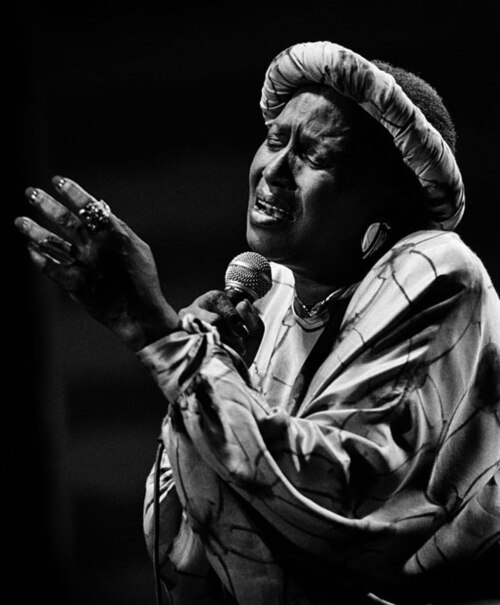
Miriam Makeba
About Miriam Makeba
Pata Pata became the song that changed everything for Mariam Makeba.
Zenzile Miriam Makeba was born on March 4, 1932, in Johannesburg to Swazi and Xhosa parents. Her childhood was marked by hardship. After her father died, she had to find work as a child to help support her family.
Her voice was noticed early. She began singing professionally in the 1950s, performing with groups like the Cuban Brothers, the Manhattan Brothers, and the Skylarks. These ensembles mixed jazz, traditional African melodies, and Western popular music.
In 1959, Makeba appeared in the anti-apartheid film Come Back, Africa. That small role opened doors across the Atlantic. She performed in Venice, London, and New York City, gaining international recognition almost overnight.
In London, she met American singer Harry Belafonte, who became her mentor and colleague. He guided her into the American music industry. She moved to New York City and became immediately popular with audiences hungry for her sound.
Her first solo album came out in 1960. That same year, she tried to return to South Africa for her mother's funeral. The government blocked her entry, a move that revealed the cost of her activism back home.
Makeba's career flourished in the United States despite her exile. She released multiple albums and became a voice against apartheid and white-minority rule in South Africa. Her music reached people who had never heard African melodies before.
She was nicknamed Mama Africa for her role in bringing the continent's music to the world. Makeba worked across genres—Afropop, jazz, and world music—refusing to stay in one lane. She died on November 9, 2008, leaving behind a legacy as both a singer and a civil rights activist who used her platform to fight injustice.
💬 Comments (0)
What do you think about Miriam Makeba? Share your thoughts.
No comments yet. Be the first to comment!