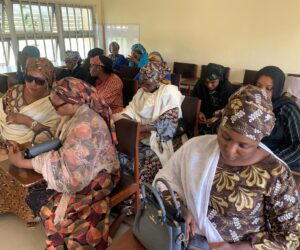
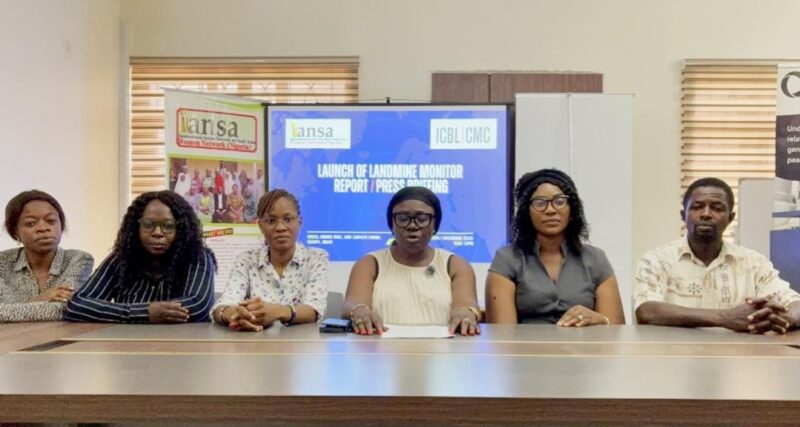

The International Action Network on Small Arms (IANSA) Women Network Nigeria has raised urgent concerns over the escalating toll of landmines on civilians, following the release of the Landmine Monitor 2025 report which reveals a sharp rise in global casualties and a disturbing retreat by five countries from the 25-year-old humanitarian Mine Ban Treaty.
In a statement signed by its Country Representative, Dr. Mimidoo Achakpa, the network described the findings as a “grave reminder that women, children, farmers, traders, and displaced families remain at the frontline of explosive violence,” warning that recent political decisions by several states threaten to reverse decades of progress in global mine action.
The report, launched by the International Campaign to Ban Landmines (ICBL), shows that 6,279 people were killed or injured in 2024, the highest annual figure since 2020, with civilians accounting for 90% of victims. Almost half of all casualties were children.
Nigeria among high-burden states
In Nigeria, the data shows persistent and deadly contamination, mainly in the Northeast. At least 418 civilians were killed or wounded in 2024 across Borno, Yobe and Adamawa due to landmines, improvised explosive devices (IEDs) and explosive remnants of war linked to Boko Haram and ISWAP.
From August 2024 to January 2025 alone, the United Nations Mine Action Service (UNMAS) recorded 101 additional victims across seven high-risk LGAs, signalling that former battlefields and mobility corridors remain heavily contaminated.
The Maiduguri–Damboa route, where a landmine blast killed eight passengers, was highlighted as one of several “high-risk civilian arteries” where safe movement, farming and humanitarian access are increasingly restricted.
Global Alarm as Mine Ban Treaty Faces Unprecedented Strain
While the report recognises progress, 31 States Parties have now completed clearance of all known antipersonnel mines, its overall message is stark. The report warns of a dangerous erosion of the Mine Ban Treaty, as Estonia, Finland, Latvia, Lithuania and Poland move to withdraw from the global ban under Article 20, a step unseen in the treaty’s history.
Ukraine’s attempt to “suspend” its obligations during conflict, which the treaty does not permit, is also described as a threat to the treaty’s integrity.
“The departure of five states in a matter of months marks an alarming moment,” said Landmine Monitor editor Mark Hiznay, noting that “when countries use mines, the suffering lasts decades after the fighting stops.”
The report also documents continued mine use by Russia and Myanmar, allegations involving Cambodia, and new use by Ukraine. It further confirms that the United States transferred antipersonnel mines to Ukraine in 2024, breaking a 32-year moratorium and undermining global norms.
Funding Crisis Deepens
The report reveals steep declines in mine action funding. Donor contributions for victim assistance, already only 5% of mine action financing, fell by almost 25% in 2024. The crisis intensified after the U.S. froze foreign assistance in early 2025, leading to the termination of several mine action programmes.
“Behind each statistic is a family and a community still living with the consequences,” said Ruth Bottomley, Landmine Monitor editor for mine action funding. “The drop in support for survivors is alarming and must be urgently reversed.”
IANSA Women Network Nigeria calls for stronger action
Dr. Achakpa stressed that the impact of landmines is deeply gendered, disproportionately affecting women and girls who face heightened risks while fetching water, farming, collecting firewood or returning home after displacement. She emphasized that weakened global commitments would worsen vulnerabilities for communities already dealing with conflict, poverty and displacement.
“We cannot allow political reversals to erase twenty-five years of progress,” she said.
“Nigeria must join other committed states in defending the Mine Ban Treaty, pressing for renewed global unity, and strengthening domestic mine action and survivor assistance.”
Tamar Gabelnick, Director of ICBL, echoed the call, urging governments to “speak out to uphold the treaty, prevent further departures, and ensure no more countries use or produce antipersonnel mines. Turning back is not an option; the human cost is too high.”
The Landmine Monitor 2025 report was released as states convened today in Geneva for the Twenty-Second Meeting of States Parties to the Mine Ban Treaty, where growing concerns over treaty compliance and donor fatigue are expected to dominate discussions.
About IANSA Women Network Nigeria
Established in 2005, the network brings together women’s groups across Nigeria committed to reducing the proliferation and impact of small arms and light weapons. It promotes peace, sustainable development, disarmament, demining, and gender equality, with a focus on the specific vulnerabilities faced by women and girls in conflict and post-conflict environments.