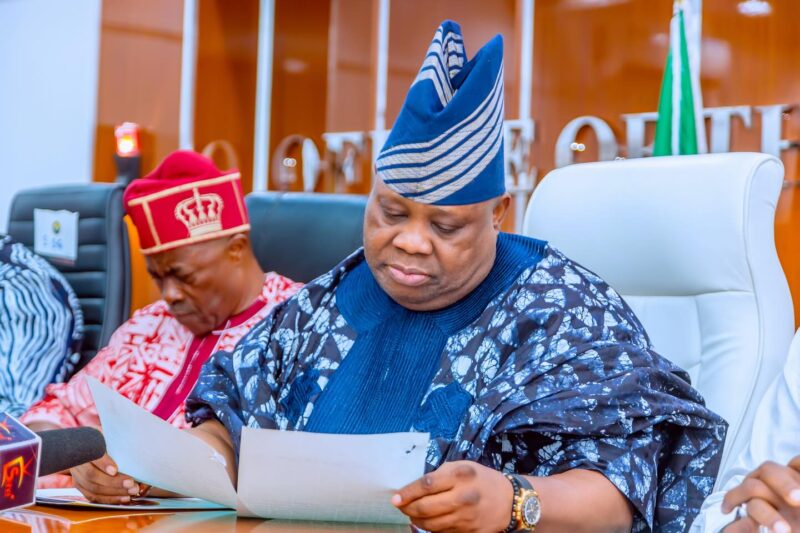
Osun State Governor Ademola Adeleke on Monday announced his resignation from the Peoples Democratic Party (PDP), on whose platform he had been elected a senator and subsequently a governor. His spokesperson, who broke the news in a press statement, said the governor had resigned since 4 November, but did not explain why such a consequential political step was hidden from the public for close to a month.
Though the governor attributed his exit from PDP to the national leadership crisis, the decision was neither abrupt nor unexpected. It was the culmination of months of factional battles, and an increasingly dicey electoral timetable that closed in on him.


Nevertheless, the timing of the disclosure and the reason given for the governor’s decision have drawn less interest than what the announcement did not contain: which party is Governor Adeleke joining to seek re-election for a second term in office come 2026.
PREMIUM TIMES reviews the build-up, the political undercurrents and what’s next for Governor Adeleke.
A party in disarray
Since losing the 2015 general elections, the PDP, Nigeria’s ruling party for 16 years harking back to the inception of the Fourth Republic in 1999, slowly began to lose influence.
By mid-2025, the PDP had been bitterly fractured into rival factions, with each side claiming legitimacy and trying to control national leadership, while its top political office holders including governors, federal and state lawmakers and their allies left in droves.


For Osun State, where Governor Adeleke is expected to seek a second term in 2026, the crisis effectively stalled all mandatory pre-primary processes. Ward congresses scheduled for November were aborted, local government delegate elections could not be held, and the governorship primary slated for 2 December was suspended. The emergence of Taminu Turaki as the national chairman of the party at a convention held in defiance to court orders casts a shadow of uncertainties on the legality of any action, including organising congresses, arranging primaries and nomination of candidates to the Independent National Electoral Commission (INEC), which the new national officers may undertake. For a sitting governor approaching a strict INEC deadline of 15 December, this was politically fatal.
While the PDP’s national feud raged, Governor Adeleke found himself politically boxed in. He had collected and submitted his nomination forms and had even been screened by the party, but these formalities became meaningless once the primary process became shaky.
Party insiders say the governor repeatedly pressed the national leadership for clarity or at least assurances that the party could meet INEC’s December deadline for governorship nomination processes. None came. Instead, the cracks widened. Different factions advanced different timetables, some pushed for postponements, while others pressed Governor Adeleke to defect early and avoid being stranded.
By November, the governor’s allies privately conceded that the PDP, in its current condition, lacked the organisational capacity to field a standard-bearer in Osun.
The vacuum created by the PDP crisis opened the door for political manoeuvring. Rumours swirled that Governor Adeleke was in talks with other parties, including the African Democratic Congress (ADC) and the Accord Party about a possible switch. His team publicly denied these reports, but the speculation reflected growing doubts within his own camp about the viability of the PDP ticket.
Opposition forces in the state seized the moment, framing Governor Adeleke as uncertain of his political home and predicting a collapse of the ruling coalition in Osun. Within the PDP, mistrust deepened. Some party figures accused the governor of withholding resources from party activities, anticipating an exit. Others blamed the national feud for creating conditions that forced such speculation in the first place.
Either way, the governor’s confidence in the party’s ability to deliver a legitimate primary had evaporated.
The exit
The decisive step to leave the PDP came as expected. On 4 November, Governor Adeleke submitted a resignation letter to his ward executives in Ede North, his spokesperson said. Its contents were kept confidential until 1 December, when his spokesperson publicly confirmed the development.
In the letter, titled ‘Resignation of my membership of the People’s Democratic Party (PDP)’, the governor cited the national crisis as reason for his withdrawal from the party. He made no immediate announcement of a new political platform.
“Due to the current crisis of the national leadership of the People’s Democratic Party (PDP), I hereby resign my Membership of the People’s Democratic Party with immediate effect.
“I thank the Peoples Democratic Party for the opportunities given to me for my elections as a Senator (Represented Osun West) and as Governor of Osun State under the People’s Democratic Party,” the Governor stated.
The resignation was a calculated move to guarantee a second term as governor.
Governor Adeleke’s exit from the PDP has effectively reset the political landscape of Osun State. The obvious implication is a weakened PDP. Without its most visible and electorally successful figure, the PDP’s structure in Osun faces an existential crisis. The factional cracks exposed by the national dispute are likely to widen, and the party may struggle to field a competitive candidate.
A new political alignment is now in the making as the governor must now identify a new platform for his 2026 bid. Whether he opts for a major party or a smaller one that can negotiate alliances, his move will reshape coalitions statewide.
In his reaction, the Turaki–led PDP said it has not received any formal notice from Governor Adeleke announcing his resignation. However, he added that Governor Adeleke has every constitutional right to remain in the PDP or to leave, noting that the choice rests entirely with him.
Governor Adeleke’s exit brings to six the number of governors who have left the PDP in recent times. The others are Peter Mbah of Enugu State, Umo Eno of Akwa Ibom, Douye Diri of Bayelsa, Sheriff Oborevwori of Delta, and Agbu Kefas of Taraba. All of them defected to the All Progressives Party (APC), the party in control of the federal government.
What’s next?
A journalist, Mojeed Alabi, who shared insights with PREMIUM TIMES on the political developments in the build-up to the 2026 Osun State governorship election, recalled that in the wake of the PDP meltdown, Governor Adeleke had attempted to defect to the APC. The move was spurred by the backing he received from figures close to President Bola Tinubu.
In June, Governor Adeleke, alongside his elder brother, Deji Adeleke, and his nephew, Afrobeat singer, David Adeleke, visited President Tinubu at his private residence in Ikoyi, Lagos.
While the details of the meeting were not made public, political observers believed it was part of moves for Governor Adeleke to defect to the APC.
However, the move collapsed because of, among other factors, the cold shoulder from the current Minister of Marine and Blue Economy and former governor of the state, Gboyega Oyetola, who contested but lost the 2022 governorship election to Mr Adeleke.
Mr Oyetola, who is the leader of the APC in Osun, being the highest political office holder from the state, was said to have ruled out automatic control and guaranteed 2026 governorship ticket of the party for Governor Adeleke in the event he joined the party.
The minister’s stance sat well with many leaders and members of the APC in the state, who consistently voiced their opposition to Mr Adeleke’s behind-the-scenes moves to cross-carpet to the party.
“Oyetola insisted that even if he had come, he would not be provided with an automatic ticket. The Osun APC insisted that he should not come unless he is ready to struggle for the ticket. When they knew it would not be handed over to them, they discarded the plan,” Mr Alabi said.
Weighing in on the matter, the chairperson of the Civil Society Coalition in Osun State, Wahid Lawal, said APC’s leadership in the state rebuffed Mr Adeleke’s attempt to join the party.
He explained that some APC leaders feared that admitting the governor would automatically make him the party’s top leader in the state, an outcome they were unwilling to accept.
“Some people believe if he came into APC, he would automatically become the party’s leader. And some have been working around the clock in their party; they don’t want anybody that will come and become their leader overnight,” he noted.
As a result of these hurdles, Mr Adeleke abandoned the plan to cross to APC.
The option of the ADC, a relatively new party in the state but which is steadily gaining momentum driven by Rauf Aregbesola, the immediate-past Minister of Interior and former Osun governor, has also closed against Mr Adeleke. Mr Adeleke’s outlook on ADC is similar to the APC situation. Joining the ADC without clear assurances from Mr Aregbesola, who is the national secretary of the ADC and appears to have settled for a candidate, would amount to Mr Adeleke shipwrecking his second term before the actual race. Although the governor’s camp already cancelled out ADC on the governor’s slate.
In the aftermath of Mr Adeleke’s resignation from the PDP, the Commissioner for Information and Public Enlightenment, Kolapo Alimi, said the governor is expected to announce a new political home before 13 December.
Already, the Accord Party has begun moves to woo Governor Adeleke. The Lagos State Chairman of the party, Dele Oladeji, said Accord Party will be happy to have the governor to actualise his second-term ambition, News Agency of Nigeria (NAN) reported.
Mr Lawal noted that the Accord Party could serve as a viable platform if the governor can transfer his political structure into the party.
READ ALSO: Osun PDP Reps attack Gov Makinde, reject party’s primary election
He cited the example of former Ondo State Governor, Olusegun Mimiko, who in 2026 left the PDP for the Labour Party, which was barely known in the state at the time, but still won the governorship through the strength of his personal political machinery.
“Labour Party had no structure there. But because he had his own structure, he put that structure in place and won. I may not be surprised if the governor went to the Accord Party and won. But politics is not ‘two plus two equals four’,” he said.
In the meantime, it appears that the PDP has moved on as a faction of the party in Osun State went ahead with its governorship primary in Osogbo on Tuesday, a day after Mr Adeleke made his exit from the party public.
Party leaders at the national level had insisted the election would proceed on schedule, even though Governor Adeleke was reportedly the only aspirant to have collected the nomination form. But earlier, Sunday Bisi, the Osun PDP state chairman, had announced that the event had been postponed
At the end of the exercise, Adedamola Adebayo was declared the PDP candidate for the 2026 Osun governorship election, securing 919 of the 957 votes cast by accredited delegates during the primary held in Osogbo.
With options closing rapidly and the December 15 primary deadline approaching, Governor Adeleke may consider the Accord Party, although its limited reach in the party is a matter he would ponder on in devising his re-election strategy.