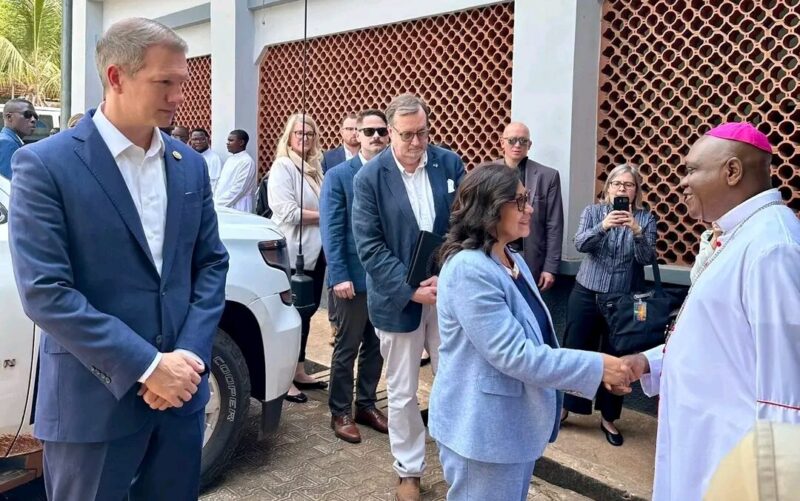
United States Congressman Riley Moore has called for stronger international engagement with Nigeria’s worsening displacement crisis after a visit to several internally displaced persons (IDP) camps in Benue State.
Mr Moore, who was in the state earlier in the week, said he met dozens of people who described attacks that forced them from their homes and left entire families dead.


Writing on X on Wednesday, the congressman said the accounts he heard from survivors would “remain with me for the rest of my life.”
He said one woman told him she was forced to watch as her husband and five children were killed. Another said her child was ripped from her womb during an attack that claimed the rest of her family.
A man he met said his relatives were “hacked to death” and that his arm was permanently damaged while attempting to flee.
Mr Moore said more than 600,000 displaced Christians are currently living in camps across Benue, a state that has endured years of recurring violence involving armed groups and farming communities.

Mr Moore also held meetings with the Bishop of Makurdi, Wilfred Anagbe, Bishop Isaac Dugu of Katsina-Ala, and Tiv traditional ruler James Ioruza.
 He described the engagement as “deeply moving,” adding that the United States “will not ignore what we heard from local communities.”
The visit forms part of a growing wave of international commentary on the crisis.
Security consultations in Abuja
Mr Moore said his trip to Nigeria included talks in Abuja with National Security Adviser Nuhu Ribadu and other senior officials.
He said discussions centred on terrorism in the North-east and persistent killings in the Middle Belt, which he described as priority issues for both President Donald Trump and himself.
He also praised the recent rescue of more than 100 abducted Catholic schoolchildren, noting what he described as “progress” through what he called an established joint US-Nigeria task force.
 The NSA confirmed meeting the US delegation as part of ongoing counter-terrorism and security consultations.
Mr Ribadu said the talks followed earlier engagements in Washington and covered regional stability and ways to strengthen the strategic partnership between both countries.
This renewed diplomatic activity comes amid heightened tensions between Abuja and Washington following the Trump administration’s redesignation of Nigeria as a Country of Particular Concern over alleged religious freedom violations.
Prior disputes over claims of Christian genocide
Mr Moore’s visit follows months of debate in the United States and Nigeria over whether the violence constitutes a campaign of genocide against Christians.
On 15 October, former mayor of Blanco, Texas, Mike Arnold, presented a report in Abuja insisting that the killings and displacement in northern and central Nigeria amount to genocide.
Mr Arnold, founder of Africa Arise International, said the conclusion was based on more than five years of field visits, interviews and documentation.
He told journalists he had made 15 trips to Nigeria since 2010, including six investigative missions since 2019. He said he interviewed governors, ministers, traditional rulers and former presidents, and recorded about 80 hours of testimony in communities affected by attacks in Bokkos, Jos, and Gwoza.
Mr Arnold argued that Nigeria’s deterioration from relative stability in 2010 to widespread displacement was the result of political manipulation and foreign interference.
He alleged that fighters from Libya and the Sahel arrived after the 2011 Arab Spring and joined Boko Haram and ISWAP in a “calculated campaign of radical Islamic conquest.”
He claimed more than four million Nigerians have been displaced, “mostly Christians,” and criticised officials for describing the situation as farmer-herder clashes, which he called a “cynical euphemism.”
His position was immediately rejected at the briefing by Reno Omokri, a former presidential spokesperson, who described the claim of genocide as inaccurate. Khalid Aliyu, secretary-general of Jama’at Nasril Islam (JNI), was also present.
Trump’s warning and threat of military action
The debate escalated further on 1 November when President Trump threatened to cut off aid to Nigeria and ordered the Pentagon to prepare for possible military action. In a social media post, he accused the Nigerian government of failing to protect Christians and warned of “fast, vicious and sweet” action if the killings continue.
He also described Nigeria as a “country of particular concern,” a designation the administration had announced earlier.
President Bola Ahmed Tinubu responded by reaffirming Nigeria’s constitutional protection of all faiths and denied that the state encourages religious persecution. He said Nigeria remains willing to work with the United States, adding that religious freedom “has always been a core tenet of our collective identity.”
US government documents estimate Nigeria’s population at about 225 million, with Muslims representing about 50 percent and Christians about 48 percent. The rest belong to other faiths or none.
Rising diplomatic scrutiny
Mr Moore’s visit to Benue came days after the US House Subcommittee on Africa held a public hearing on the implications of the redesignation, and shortly after Trump instructed Congressman Moore and the House Appropriations Committee to investigate reports of Christian killings and report back to the White House.
READ ALSO: NCDC supports Ajaokuta Economic City, to pursue dredging, rail connectivity development
The federal government has repeatedly rejected allegations of systematic persecution of Christians, insisting that insecurity affects citizens of all faiths and is driven by multiple factors including banditry, terrorism, and long-running land and resource disputes.
What remains clear is that the testimonies recorded in Benue this week, the political disputes in Abuja in October, and Washington’s increasingly forceful rhetoric in November have now converged, placing Nigeria’s internal security crisis under intensified international scrutiny.