
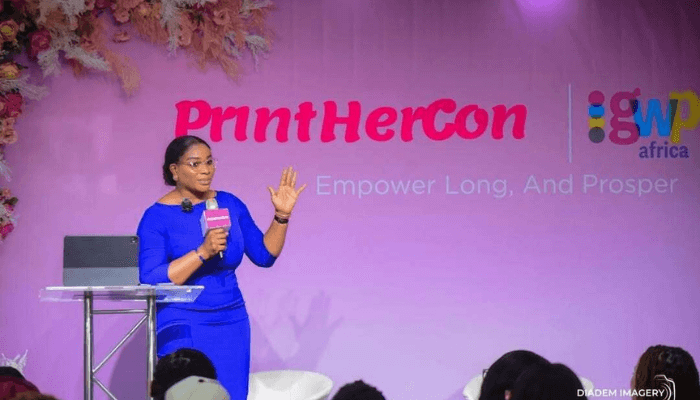
At the Girls Who Print Africa 2025 Conference, Tonya Lawani, founder of The Quick Print Shop and CEO of SEAL Group, made a case for the use of artificial intelligence in Nigeria’s printing sector. Speaking to an audience of printers, designers, and entrepreneurs, she argued that AI could help modernise production, reduce waste, and create new opportunities for skilled workers — particularly for women in the industry.
In her keynote, titled “Reimagining Print in the Age of AI: How Women Are Reshaping the Industry,” Lawani outlined a practical approach for integrating AI into printing operations. Her advice was straightforward: identify a specific business problem, pilot a focused AI solution, and combine technology with human oversight and re-skilling programs. She emphasised that AI should enhance craftsmanship, not replace human judgment.
Lawani drew on her own experience with The Quick Print Shop, which she established in 2015. Faced with inconsistent quality and long lead times from outsourced suppliers, the company invested in an end-to-end production facility in Shomolu, incorporating automation for pre-press checks and colour matching. The results were clear: fewer reprints, faster client approvals, and improved efficiency — demonstrating that careful, measured adoption of AI can deliver tangible benefits.
With over two decades of experience leading businesses across hospitality, merchandising, advertising, printing, and events, Lawani brings a wealth of practical insight to the sector. As CEO of SEAL Group, she oversees a portfolio that includes The Quick Print Shop, Virgin Vie Angel, ABC Inflatables Nigeria Ltd, The Virgin Hospitality Company, and Expose Et Al, serving national and multinational clients such as Dangote Group, MTN, UBA, Multichoice, Reckitt Benckiser, Cadbury, Samsung, and Nestlé. Her background in building and scaling businesses provides her with a unique perspective on how technology can transform traditional industries like printing.
Her session sparked discussion on the need for responsible AI adoption, including environmental considerations and workforce reskilling. For many attendees, the conference reinforced that technology, when paired with human oversight, could be a key tool in modernising Nigeria’s print industry while creating new opportunities for women.