
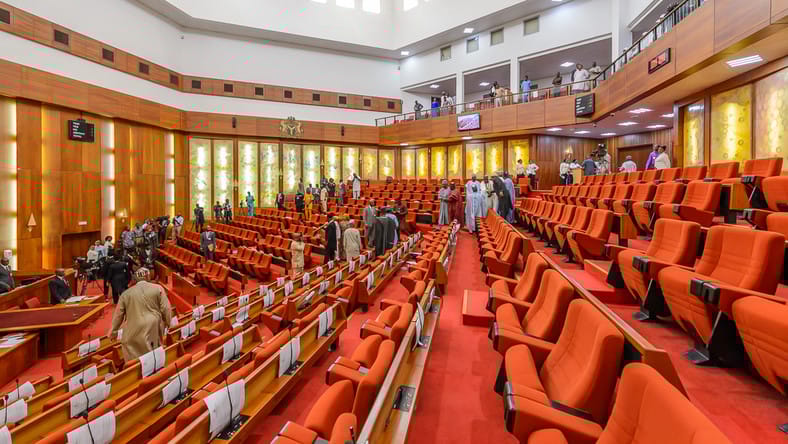
The Senate has approved a resolution prescribing the death penalty for anyone convicted of kidnapping or other acts classified as terrorism.
Lawmakers also resolved that kidnapping should henceforth be legally designated as a terrorist offence, with an amendment to the Terrorism (Prevention) Act to reflect the new penalty.
Under the proposal, once a court establishes a kidnapping conviction, the maximum penalty—death—must be applied.
The decision followed heated deliberations on Wednesday as lawmakers debated the worsening insecurity across the country.
The motion, titled Urgent Need to Address Escalating Insecurity in Kwara, Kebbi, and Niger States, call for Immediate and Comprehensive Federal Intervention, was moved by Deputy Senate Leader, Senator Lola Ashiru.
The Senate expressed deep concern over the November 18, 2025 attack on Christ Apostolic Church (CAC), Eruku, in Ekiti Local Government Area of Kwara State, where heavily armed assailants killed two worshippers and abducted 38 others.
All victims were later rescued following coordinated security operations.
Lawmakers noted that the attack triggered the shutdown of schools across five local government areas in Kwara—Ekiti, Ìsìn, Irepodun, Ifelodun, and Oke-Ero—as well as across Kebbi and Niger States.
Read also: Deliberate closure of schools by government marks new low in Nigeria’s battle with insecurity
All 47 Federal Unity Colleges nationwide were also closed, disrupting the education of thousands of children and reflecting the extent of public fear.
They further linked the Eruku incident to a growing pattern of mass abductions, including recent kidnappings of schoolchildren in Kebbi and Niger States. Senators voiced alarm over the vulnerability of schools, worship centres, and rural communities to bandits and terror groups.
The chamber also called for a transparent investigation into reports that military personnel were withdrawn from a Kebbi school just hours before bandits struck, raising “grave questions” about security lapses.
Senators cited intelligence suggesting internal collaborators, motivated by financial or political interests, regularly aid criminal gangs with information, logistics and escape routes, contributing to the escalation of attacks.
They warned that armed groups have adopted more sophisticated tactics, including communication interception, surveillance of soft targets, and scavenging personal belongings after raids.
Criminals also exploit porous forest corridors such as the Kwara–Kogi axis, the Kebbi–Zamfara route, and the Shiroro–Rafi–Munya belt in Niger State, complicating rescue operations.
Debate also highlighted that insurgent activities are spreading into Osun State, while communities like Eruku, Isapa, and Koro—all Ekiti-speaking communities within Kwara—have witnessed repeated attacks. In Koro, a traditional ruler and retired army general was recently murdered by bandits.
Lawmakers lamented that the dilapidated Idofian–Omu-Aran–Eruku–Egbe–Kabba federal highway has become an enabler of criminal activity, providing bandits with escape routes and ambush points.
Read also: Tinubu confirm rescue of 38 kidnapped worshipers
The Senate noted that Kwara South alone has recorded more than 40 abductions in 18 months, mirroring spiralling insecurity in neighbouring states.
They warned that continued inaction risks mass displacement, prolonged school closures, destruction of rural livelihoods, and long-term psychological trauma for children.
The chamber commended President Bola Ahmed Tinubu for what it described as “exemplary leadership” and his decision to cancel foreign trips to personally oversee the response to the Eruku, Kebbi, and Niger incidents.
Lawmakers acknowledged the Federal Government’s interventions, which led to the rescue of 51 abducted students in Niger and the 38 victims in Kwara.
They also praised the resilience of affected communities, particularly vigilante groups in Eruku, and expressed solidarity with residents of Kebbi and Niger States.