2
ABUJA – In an idea situation, social protection encompasses a comprehensive, effective and sustainable system that protects people or citizens from poverty, vulnerability to harsh economic policies and above all social exclusion throughout their life cycle.
Unfortunately, while roboust social protection systems have gained root in more advanced climes of the world, it is still a topic for endless debates as its adaptation is abysmally low in third world countries, Nigeria inclusive.
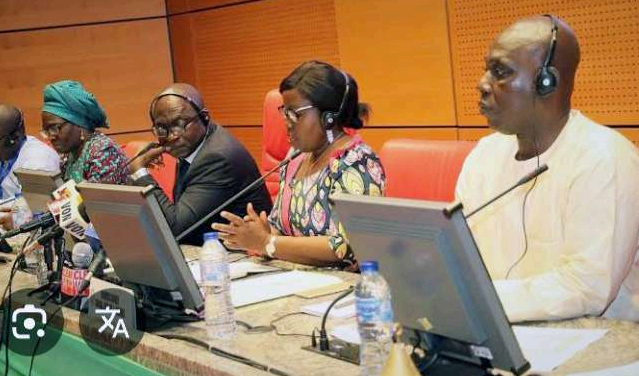
Prominent organizations such as the International Labour Organisation(ILO), World Bank, UNICEF among others do have a set principles for social protection policies to thrive, but in West Africa, these observed lapses came up for deliberations again at the Organization of Trade Unions of West Africa (OTUWA/ DTDA Workshop, which centred on Financing Social Protection and Just Transition in West Africa.
The thought provoking workshop held between November 21-22nd, 2025 in Nigeria’s capital, Abuja.
Setting the stage for the deliberations, Acting President of OTUWA, Comrade Sophie Kourouma told delegates that the conference was organised against a backdrop of severe challenges.
She explained that the theme for this year’s conference gained traction because of the stark reality that West Africa still suffers from one of the lowest social protection coverages in the world, a figure that falls dismally below the already low African average.
According to Kourouma, in the Sahel region, the deficit is nothing short of a crisis, leaving millions of our brothers and sisters exposed to the ravages of poverty, economic shocks, and now, the accelerating impacts of climate crisis.
She noted that mounting insecurities resulting from terrorist activities has made the situation more dire, a reality key stakeholders can no longer afford to ignore.
While calling for a change in strategy, and backing words with action, she insisted that all stakeholders must firmly establish a foundational principle because social protection is not a privilege bestowed by a benevolent state; but a fundamental human right which is the bedrock upon which we build resilient societies.
“This rights-based approach is what gives moral and political weight to the recently launched ECOWAS Social Protection Framework and its Operational Plan.
“We cannot discuss social protection in a vacuum. The existential threat of our time, climate change, is already reshaping our economies and devastating our communities. From coastal erosion swallowing livelihoods in the Gulf of Guinea to desertification fuelling conflict in the Sahel, the impacts are here and now.
“We have heard the poignant, powerful question from a citizen in our region: “You come from the city — you have electricity, you have lighting. Why you and not us? We’re human beings like you, and we need electricity too.”
“This cry for justice and equity must be at the core of our response,” Kourouma stated.
Also lending her voice on just transition, the OTUWA President said it is the necessary bridge between our climate ambitions and our social justice imperatives.
“As trade unions we understand the necessity to curb the wanton erosion of our environment caused by massive industrial and exploration activities of humans.
However these remediation measures must take account of how these affect workers hence our just demand to be included in the processes of how we will tackle the problems posed by climate change and climate disruptions.
“As participants our discussion centres on what’s already happening to address the twin challenges of social protection and just transition especially in our subregion and experiences from elsewhere and in the end work on a platform of action for trade unions in our subregion as well as our allies in the civil society.
“This workshop is aimed at deepening participants understanding of financial challenges and opportunities of social protection and just Transition in the West African context. Exploring and analyzing diverse national and international financing mechanisms relevant to funding social protection and just transition.
“It is also aimed at equipping participants with tools and strategies for effective trade union and civil society advocacy and engagement in national dialogues and develop concrete national action plans for participating unions including targeting coalition building with civil society organizations and monitoring framework for financing of social protection and just transition,” she noted.
Nigeria’s Minister of Labour and Employment, Muhammad Dingyadi who shared a similar perspective on the social protection and just transition subject noted that it has become a critical pillar for inclusive growth, economic stability, and human development.
According to the Minister, as nations recover from global shocks—including economic disruptions, insecurity, inflation, and climate-related disasters—strong social protection systems have proven essential to protecting livelihoods, promoting productivity, and safeguarding the most vulnerable groups.
He acknowledged that it has become germane now that the world is undergoing a profound transformation towards greener, more sustainable economies.
“For Nigeria, this transition offers opportunities for innovation, new jobs, and cleaner energy. However, it also comes with challenges that require proactive planning to ensure fairness, equity, and economic resilience. This is what we call a Just Transition.
“This workshop brings these two priorities together how do we finance sustainable and shock-responsive social protection? how do we ensure that our transition to a green economy is inclusive, just, and protects workers across all sectors?
“The Federal Government of Nigeria remains deeply committed to strengthening social protection as part of our national development strategies. Under the leadership of His Excellency, President Bola Ahmed Tinibu significant steps have been taken to expand social assistance programmes, including cash transfers and livelihood support.
“Strengthen contributory social insurance schemes for workers in both formal and informal sectors, enhance labour market policies aimed at skills development, decent jobs, and productivity. Integrate climate-responsive measures into employment and social protection planning.
“Our Ministry, in collaboration with the relevant MDAs with the supports of our social partners is advancing frameworks that support universal coverage, improved accountability, and sustainable financing mechanisms.
“Let us remain guided by the principle that social protection is not a cost—it is an investment in human capital, productivity, and national stability. A well-financed social protection system is essential for a peaceful, inclusive, and prosperous Nigeria. Likewise, a Just Transition is not optional; it is necessary for safeguarding our nation’s future in a rapidly changing global environment,” the Minister noted.