Some experts drawn from the academia, the civil society and government institutions on Thursday called fortraining of law enforcement officers, including those of the police, on respect for human rights principles, crowd control skills, and use of proportional forces in deserving situations.
A Senior Advocate of Nigeria and Dean of the Faculty of Law, University of Jos, Dakas Dakas, a leading voice on the matter, said the training will help law Nigerian law enforcement agents to make sound decisions under pressure.


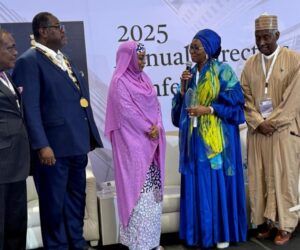
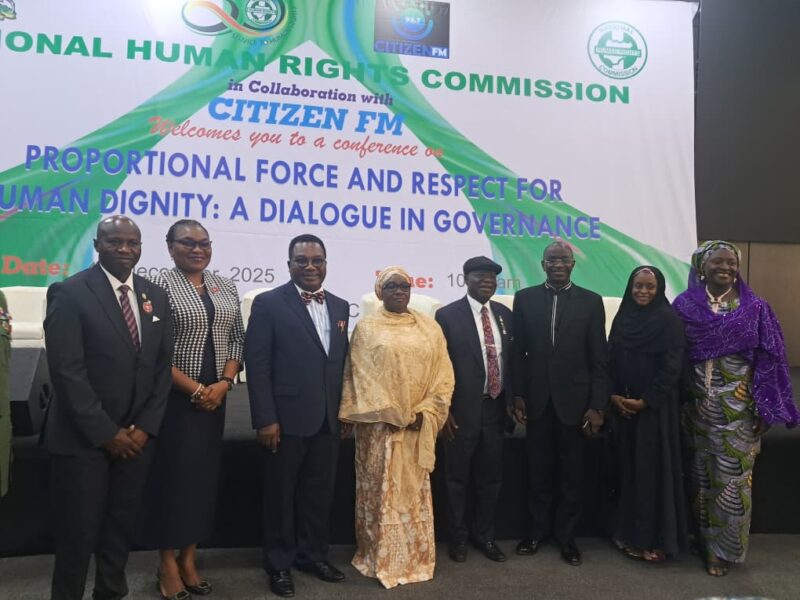
Mr Dakas and other contributors, including the Executive Secretary of the National Human Rights Commission (NHRC), Tony Ojukwu, and the chairperson of the National Drug Law and Enforcement Agency (NDLEA), Buba Marwa, spoke at a conference organised by the NHRC in collaboration with Citizen FM.

The event was themed, ‘Proportional force and respect for human dignity: a dialogue in governance,’ in Abuja.
“Strengthen training curricula. Training should include human rights principles, communication and de-escalation skills, crowd management scenario-based exercises, stress-management and decision-making under pressure,” Mr Dakas said.
Equipping law enforcement officers and need for proportionality of force
The don, who cited a study, ‘Use of Force by Law Enforcement Officials in Africa,’ in his submissions echoing the recommendations contained in the research report, said there was the need to equip law enforcement officers with the appropriate tools.


“Equip officers with adequate less-lethal tools,” he said, adding, “If officers have more tools, they make better choices. Create independent oversight and complaint mechanisms. This promotes accountability and restores public trust and improves management of public assemblies.”

Mr Dakas urged law enforcement officers not to see proportionality as weakness. “It is precision, discipline, and professionalism,” he said.
He further noted that proportional use of force and the protection of human dignity should be seen as core issues of governance that uphold state legitimacy and order in society.
Drawing on the experience of #EndSARS protests and the Lekki Toll Gate tragedy, Mr Dakas said disproportionate use of force escalated into “national legitimacy crises, youth disaffection, erosion of international confidence, economic disruption, and long-term institutional distrust.”
In his submission, the Executive Secretary of the NHRC, Mr Ojukwu, noted that disproportionate force “should be considered as torture, cruel, inhuman or degrading treatment or punishment unless good faith on the part of the officer is established beyond a reasonable doubt.”
Similarly, the NDLEA chair, Mr Marwa, advised: “The deployment of force by state institutions must always be guided by the principle of proportionality, grounded in law, informed by necessity, and applied with restraint.”
Mr Marwa said proportional force ensures that even in the face of provocation or imminent threat, the response of the state remains measured, justified, and accountable.
A PREMIUM TIMES report Times documented indiscriminate use of teargas against public gatherings in recent time, tracing a pattern of excessive use of force and unprofessional conduct by law enforcement officers. The report also highlighted the negative implications of disproportionate use of force for citizens’ rights and health as well as Nigeria’s democracy.
Mr Ojukwu said Nigeria’s complex security challenges—including terrorism, insurgency, and banditry—warranted the discourse.
“This dialogue is not about assigning blame; It is about ensuring that security operations are guided by both constitutional and international standards, and that reforms are established through collective engagements with relevant stakeholders,” he said.
He also noted that the goal was to strengthen accountability to ensure the national security framework is both effective in addressing challenges and humane in its execution.
Trust crisis
Similarly speaking during a panel session that brought together military actors from the army, navy and air force, Hauwa Shafi’i, a journalist with HumAngle, highlighted her experience with citizens at the grassroots, plagued by insecurity and natural disasters.
Ms Shafi’i stated that these individuals hardly turn to law enforcement officers to complain of human violations because of the lack of trust triggered by their experiences with officers.
According to a report, 50 per cent of Nigerians in 2022 lacked faith in the police, 30 per cent had a little faith, 12 per cent had somewhat trust, and only 3 per cent showed complete trust.
READ ALSO: Oxford begins first human trial of new Lassa Fever vaccine
This distrust remains a continuous discourse in Nigeria. In 2020, distrust drove youths to the streets to protest. In the end, the protest created more of a divide than a bridge between Nigerians and law enforcement officers.
Representing the Chief Justice of Nigeria, Kudirat Kekere-Edun, the Administrator of the National Judicial Institute (NJI), Babatunde Adejumo commended the NHRC for its “continued leadership in convening dialogue, deepening public awareness and promoting ethical conduct is therefore commendable and indispensable.”
Prominent dignitaries attended the event, including the representatives of the governors of Kaduna and Katsina states, the Deputy Governor, Hadiza Balarabe, and the Attorney General of Katsina State, Fadila Muhammed. There were also attendees from various security agencies and civil society organisations.