The decision by Nigeria’s 19 northern governors to establish a Regional Security Trust Fund, with each state contributing N1 billion monthly, represents the most significant coordinated response to the region’s escalating security crisis in recent memory.
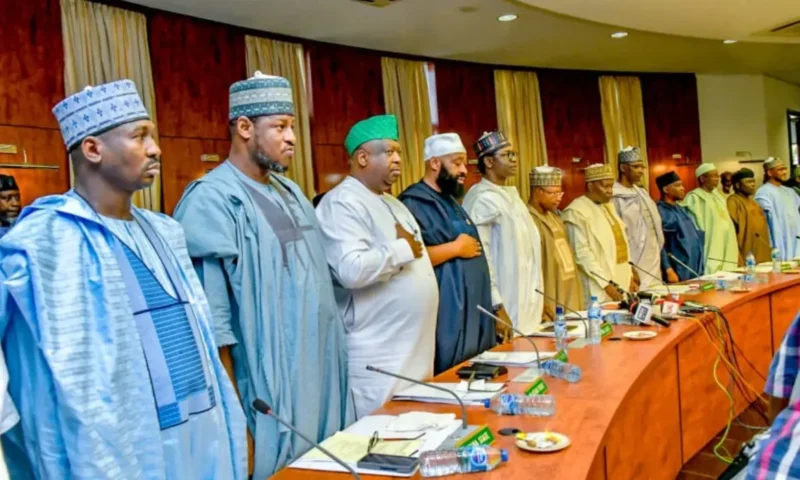
Following their joint meeting with traditional rulers in Kaduna on Monday, the governors have put N228 billion annually on the table to confront an emergency that has turned large swathes of northern Nigeria into killing fields. For a region that has watched its children snatched from schools, its farmers driven from their lands, and entire communities held hostage by bandits and terrorists, this initiative deserves careful scrutiny rather than reflexive praise.
The communiqué from the Northern States Governors’ Forum makes for sobering reading. When state governors must extend condolences to seven states simultaneously for “recent killings and abductions of school children and other innocent citizens,” we are no longer discussing isolated incidents but a systemic collapse of the state’s primary responsibility.
The governors are right to describe this as a “pivotal juncture” in the region’s history. What remains unclear is whether their proposed solution matches the scale of the catastrophe they have acknowledged.
On paper, N19 billion monthly flowing into a dedicated security fund should represent a game-changer. Yet Nigerians have learned through bitter experience that announcing funds and deploying them effectively are entirely different propositions.
The critical questions that must be answered go beyond the size of the fund to the fundamentals of governance: Who controls this money? What specific security outcomes are these billions expected to deliver? How will disbursements be tracked and evaluated? Without clear answers to these questions, the Regional Security Trust Fund risks becoming another well-intentioned initiative that enriches contractors and consultants while communities continue to bury their dead.
The governors’ call for a six-month suspension of mining exploration represents a long-overdue acknowledgment of what security analysts and local communities have been saying for years. Illegal mining operations have become the economic engine driving banditry across northern states, providing both the motivation and the funding for criminal networks that have terrorised rural areas.
Zamfara, Kaduna, Niger, and other states have watched helplessly as foreign and local miners strip their resources while armed groups collect “taxes” and protection fees. That the governors now want all mining licenses subjected to revalidation in consultation with state governments suggests previous oversight was either non-existent or deliberately compromised.
But here again, the details matter enormously. A six-month suspension means nothing if the same opaque processes that enabled illegal mining simply resume after the moratorium.
The governors must demand that the Federal Ministry of Solid Minerals Development disclose every active mining license in the north, including the beneficial owners behind corporate entities. States need real-time intelligence on mining activities within their territories, and communities affected by mining operations deserve a say in whether such activities continue.
The Forum’s unequivocal support for state police represents another necessary evolution in thinking.
That northern governors now recognise state police as essential for confronting their security challenges speaks to how desperate the situation has become.
Local knowledge, rapid response capabilities, and accountability to state governments rather than a distant federal command structure could transform security outcomes in communities that currently wait hours or days for police to respond to distress calls.
What the communiqué conspicuously omits is any frank discussion of how northern Nigeria arrived at this crisis point. The governors offer condolences and commend President Bola Tinubu’s efforts, but they do not acknowledge the policy failures, corruption, and political calculations that allowed armed groups to metastasize from nuisance to existential threat. Bandits did not suddenly materialise in 2025. They grew in strength and sophistication over years while governments at all levels prioritised political squabbles over the safety of citizens. Traditional rulers sat in the same room with governors on
Monday, yet there is no mention of the documented cases where some traditional institutions provided cover for criminals or took payments from armed groups in exchange for peace.
Beyond money and equipment, the governors must confront uncomfortable truths about governance failures that enable insecurity. How do bandits and terrorists move freely across multiple states, establish camps, and conduct operations without detection? Why have prosecutions of arrested suspects been so rare that criminal networks operate with effective impunity? What happens to weapons and vehicles recovered from bandits?
The Security Trust Fund should fund not just kinetic operations but the intelligence gathering, judicial reforms, and prison capacity necessary to dismantle criminal networks permanently.
The Forum’s call for National and State Assembly members to expedite action on state police legislation deserves similar accountability measures.
Ultimately, the N228 billion annual commitment will be judged not by press releases but by results. Can children attend school in Zamfara without fear of abduction? Can farmers in Kaduna return to their fields? Can travelers on the Abuja-Kaduna highway complete their journey without encountering bandits? These are the metrics that matter to citizens who have grown weary of government announcements that change nothing on the ground.
The northern governors have taken a significant step by pooling resources and coordinating strategy. But without radical transparency, genuine accountability, and a willingness to confront the political and institutional failures that enabled this crisis, the Regional Security Trust Fund may simply become another expensive gesture that fails to protect those who need protection most. The region cannot afford more well-funded failures. Its people deserve security they can actually see and feel in their communities.