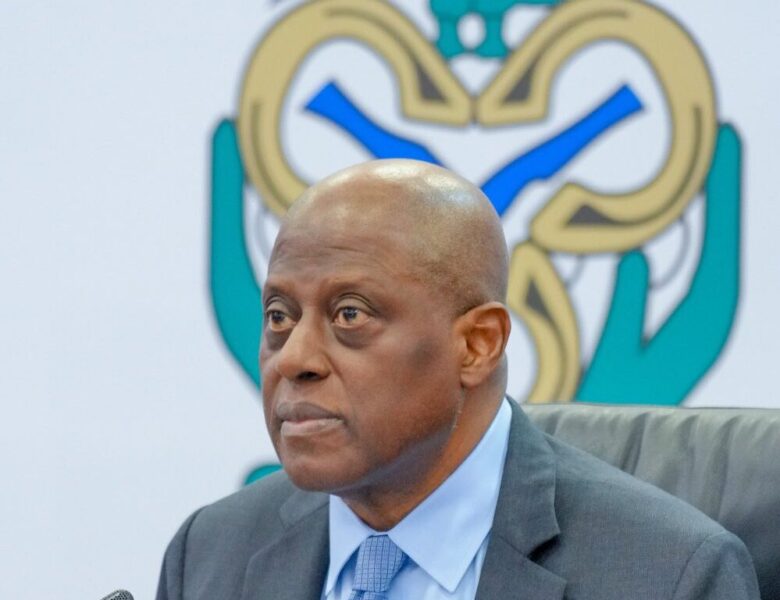
The Governor of the Central Bank of Nigeria (CBN), Olayemi Cardoso, on Thursday, said the country’s Gross Domestic Product (GDP) declined by 0.25 per cent in the third quarter of 2025 compared to the second quarter.
Mr Cardoso explained that although Nigeria’s GDP expanded by 3.98 per cent in Q3 2025, a growth higher than the 3.86 per cent recorded in the same quarter of 2024, but noted that the figure fell below the 4.23 per cent growth recorded in Q2 2025.


He disclosed this during the second-half 2025 statutory briefing before the Senate Committee on Banking, Insurance and Other Financial Institutions, chaired by Lagos East Senator, Adetokunbo Abiru.
“At the domestic front, real GDP growth sustained its positive trajectory with the economy expanding by 3.98 per cent in the third quarter of 2025. This was higher than the 3.86 per cent recorded in the corresponding quarter of 2024 but 0.25 percentage lower than the preceding quarter,” he said.
Mr Cardoso attributed the growth recorded in Q3 2025 in relation to Q3 2024 to increased activities in crop production, ICT, real estate, and the financial and insurance sectors.
“The key contributors to the broad-based growth include crop production, ICT, real estate, and financial and insurance,” he added.


Nigeria’s GDP figures have long been contentious, largely because the rising poverty and high cost of living appear to contradict the government’s claims of economic expansion. While authorities consistently highlight year-on-year growth, many Nigerians dispute this, arguing that worsening hardship and soaring prices show little evidence of improvement.
Three days ago, the National Bureau of Statistics (NBS) announced that Nigeria’s GDP grew by 3.98 per cent in the third quarter of 2025, an increase from the 3.86 per cent recorded in the same period in 2024.
However, the statistics agency did not highlight that the Q3 performance represents a decline from the second quarter of 2025. NBS data shows that GDP grew by 4.23 per cent in Q2 2025 but slowed to 3.98 per cent in Q3, indicating a 0.25-percentage-point drop.
FX market stabilised
Mr Cardoso said the foreign exchange market has stabilised due to the reforms implemented by the CBN.
“The FX market stabilised following reforms, boosting investor confidence and foreign inflows and supporting broader economic activity,” he noted.
The CBN governor added that Nigeria’s external reserves have strengthened and that most banks have met the new capital requirements.
“Similarly, external reserves strengthened significantly, supported by non-oil inflows and reduced reliance on FX swap, while the bank recapitalisation programme advanced, with most banks meeting new capital requirements,” he added
Nigeria’s foreign reserve
The CBN governor also said Nigeria’s foreign reserves stood at $46.7 billion as of 14 November, its highest level in nearly seven years
“Foreign reserves have also rebounded strongly, reaching US$46.7 billion as of November 14, 2025, the highest level in nearly seven years, providing about 10.3 months of import cover in goods and services.
Equally encouraging, diaspora remittances have surged by 66.7 per cent from about US$200 million per month to around US$600 million per month in recent months,” he noted.
Mr Cardoso further announced that the CBN had resolved the $7 billion verified FX backlog, a development he said restored credibility and investor confidence. This, he noted, helped raise foreign capital inflows to $20.98 billion in the first 10 months of 2025, a 70 per cent increase over the total inflows recorded in 2024, and a 428 per cent rise from the $3.9 billion recorded in 2023.
“Another important outcome was the resolution of the US$7 billion of verified FX backlog, restoring credibility and confidence to the Nigerian economy. Consequently, foreign capital inflows reached US$20.98 billion in the first ten months of 2025, a 70% increase over the total inflows for 2024.
This also represents a 428 per cent increase, compared to the US$3.9 billion recorded in 2023, reflecting a clear resurgence in investor confidence.
The sharp increase has boosted FX liquidity, strengthened external reserves, reinforced investor confidence, supported economic growth through higher investment, and improved Nigeria’s credit profile by lowering borrowing costs,” he said.
Nigeria’s removal from the FATF grey list
Mr Cardoso also informed lawmakers that Nigeria’s removal from the Financial Action Task Force (FATF) grey list has boosted confidence in the country’s financial system.
“Completing this progress, Nigeria’s removal from the FATF grey list marks another significant milestone in restoring international confidence in our financial system.
READ ALSO: CBN sets ATM withdrawal limit at N100,000 daily
Through strengthened supervision, improved compliance reporting, enhanced data sharing, and new governance tools, we addressed the deficiencies that had kept Nigeria on the grey list.
“Mr Chairman, it is important to note that Nigeria’s exit from the grey list has immediate and tangible benefits for us and the broader economy. It reduces compliance burden on correspondent banks, improves access to international finances, and eases cross-border payments and remittances.”