
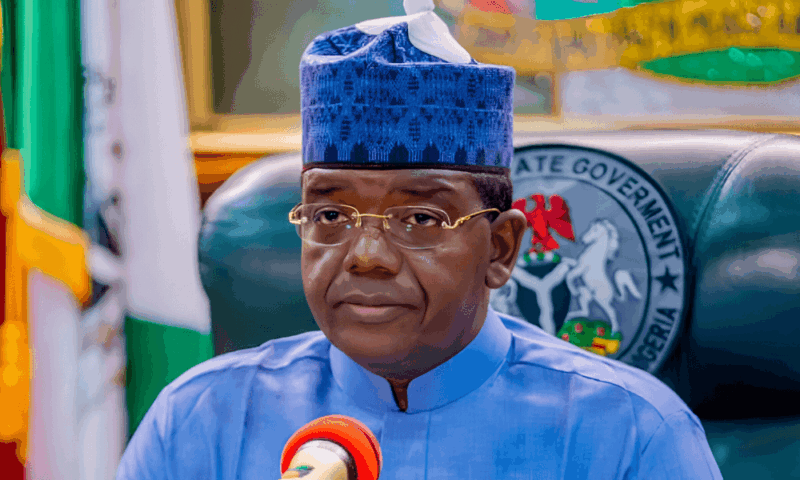
Everybody is under pressure in Nigeria at the moment. Both the government and the governed are seriously pressured. Certain decisions by the government are causing many citizens migraines. The ambassadorial list is giving many citizens sleepless nights. You may wonder why!
Can you imagine that Bello Matawalle is still hanging in as minister of state for defence after his senior colleague, Mohammed Badaru Abubakar, has been shown the exit door? Is it a case of “All animals are equal, but some are more equal than others?”
In the name of constituency projects, Nigerian lawmakers are taking their constituents for a ride.
‘Hello, Matawalle.’
In the last few days, concerns have been expressed by many Nigerians over the suitability or otherwise of Bello Matawalle as minister of state for defence.
Concerned Nigerians had used various platforms to vent their spleen over what they thought was a mistake to have appointed him in that category in the first place. Some have gone ahead to scrutinise the academic qualifications and other training acquired by Matawalle, with the aim of seeing if there has been anything that qualified him to hold such a sensitive post.
It emerged that the only qualification was that he was governor of Zamfara when over 300 schoolgirls were, in 2021, abducted from their boarding school in Jangebe, a sleepy community in the state.
Matawalle’s connection with bandits has been in the public space. While in office, he had made a case for amnesty for bandits. He said that not all bandits were criminals, as they were responding to lack of resources, bad governance, and attacks by vigilance groups.
“They normally go to their settlements and destroy property and take their animals. They did not have anyone to speak with, so sometimes, they went for revenge. When the vigilante group attacks them, they go for reprisals. That is exactly what happened,” Matawalle said in 2021.
Recently, a chieftain of the All Progressives Congress (APC) in Zamfara who resides in Abuja alleged that the minister was after his life because he was against the method adopted by Matawalle in tackling the escalating issue in the state.
A few days ago, President Bola Ahmed Tinubu dispatched the minister to Kebbi in the wake of the abduction of some school children in the state. He returned like a victorious general following the “release” of the 24 abducted pupils after deploying a “non-kinetic” approach.
With the resignation of Mohammed Badaru Abubakar, minister of defence, many Nigerians are wondering why Matawalle is still hanging in there.
“For over two years, Nigeria has not had ambassadors, and it has become a serious issue. It became more of a national embarrassment when President Donald Trump’s threat came.”
Nigerians are appealing to the President to advise the Minister of State for Defence to eat the humble pie by taking a bow. This will go a long way to showing that the President is totally committed to cleaning the Augean stables as part of the proof to the world that his administration is not sleeping on guard.
The controversial list called “ambassadorial”
At no time since the return of Nigeria to civil rule in 1999 have nominations for ambassadorial appointments elicited so much controversy as the current one.
Since Saturday, when the list hit the public space, there has been a rumpus in society. Both online and offline, Nigerians have continued to air their views.
Most of the commentators have expressed concern that some inclusions or the characters that made the list had no business being there. In the estimation of many, the condition of the country does not need a controversy arising from the ambassadorial list.
For over two years, Nigeria has not had ambassadors, and it has become a serious issue. It became more of a national embarrassment when President Donald Trump’s threat came. Many thought that the matter would not have got to the level it got if there was an ambassador in the United States.
One major reservation many Nigerians have expressed since the list of ambassador nominees was made public was the belief that political consideration trumped competence.
Many also frowned at the appointment of hate-mongers and divisive characters to represent a big country like Nigeria.
Ambassadors go to foreign lands as representatives of all citizens of their home countries irrespective of language, religion, tribe, and political persuasion. But when individuals who have consistently manifested hostility against their fellow citizens are sent off to represent such hated citizens, it means that if such citizens happen to have anything to do with the countries where the haters hold sway, they are likely to be treated shabbily or not even attended to in a foreign land.
In Nigeria, where politics is played with bile, appointments are made in a manner as if to spite those not of the same political persuasion, even if those appointments are overtly inimical to the overall progress of the country.
Another dangerous culture that may have emerged is the use of ambassadorship to reward incompetence, as it were. This dangerous trend reared its ugly head in the Muhammadu Buhari administration when some service chiefs who were total disasters in the fight against insurgency, on whose necks also hung weighty allegations of corrupt enrichment of selves, were, in a bizarre manner, rewarded with ambassadorial appointments to the consternation of many citizens.
History appears to be on playback as President Tinubu rewards Mahmoud Yakubu, immediate past chairman of the Independent National Electoral Commission (INEC), with an ambassadorial appointment.
The history of Yakubu as INEC’s boss will not be complete without the “technical glitches” episode he introduced into the nation’s electoral lexicon.
A man whom many Nigerians called for his voluntary resignation following the alleged electoral malfeasance that attended the 2023 general election he superintended but remained undisturbed has been rewarded with an ambassadorial post!
Going by academic qualifications, all the nominees are above what the constitution recommended. But a number of them are integrity-deficient. This is not hidden. It does not need any research to unravel. It is there for everyone to see.
Are we comfortable making ourselves a laughing stock in the comity of nations? Why are we fast losing steam in many areas? Why are we no longer the go-to country in Africa? Even in the Economic Community of West Africa (ECOWAS), where we used to dictate the pace, we have lost it. For instance, in the days when Nigeria was indeed the giant of Africa, Mali, Niger and Burkina Faso would not have looked her in the eye to abandon the fold; now, Guinea-Bissau may be at the exit door, having flouted the “no coup” rule in ECOWAS, nay, Africa.
This may not mean anything to us as a country at face value, but it shows how we have lost respect even from small countries that are not up to one state of Nigeria in population and landmass.
It would seem today in our dear country that poor performance begets higher responsibility. Ungentlemanly conduct in the public sphere is being taken as a standard of what should be in society.
Ordinarily, ambassadors were supposed to be men and women of proven integrity of what true Nigerian spirit represents. They were people expected to raise the banner of integrity and charm. But does it mean that we are now sending out the worst among us to the outside world? To do what exactly?
Many Nigerians saw this coming when, in August this year, bad behaviours by two Nigerians in relation to their conduct with some airlines attracted them national honours, as it were.
In our own eyes, both were awarded “ambassadors”. Although many right-thinking Nigerians screamed foul, the powers that be thought they had a superior argument. Today, the country is sinking deeper into the mire of “anyhowness” and “anything goes”.
“You have people who, if justice had prevailed and if this country had been run properly and the rules of the game were obeyed, actually should be cooling their heels in the walls of the prison and not being sent out as ambassadors,” Joe Keshi, former permanent secretary at the Ministry of Foreign Affairs, noted, questioning the character of some of the nominees.
Nobody has said that those whose names made the ambassadorial list were not qualified in their own rights; what I hear people say is that their personal and individual baggage may prove a huge albatross and could jeopardise the interest of the country and of the over 230 million Nigerians.
Even though the nomination is subject to the Senate’s approval, it is taken for granted that the Red Chamber would do its normal “rubber-stamping”.
While Nigerians await the fruit of their representation in months to come, we can only say, “Nigeria, we hail thee!”
Lawmakers in wishy-washy constituency projects
In Nigeria, the more you look, the less you see. Matters of governance are like a film trick. Those who rode to the political office on the back of people’s votes treat them with contempt in the name of constituency projects.
Most of these empowerment programmes and projects are targeted to a few cronies. The lawmakers visit their constituencies on some special occasions, particularly during festivities. They buy a few sewing machines, grinding machines, motorcycles, Keke Napeps, a few bags of rice and some other food items, and they sink a few boreholes here and there, which are hardly maintained.
Most times, constituents cannot point to anything from year to year that they benefited from from their representatives, either tangible or intangible. Someone truly pointed out that “the bar for performance is extremely low, unfortunately.”