
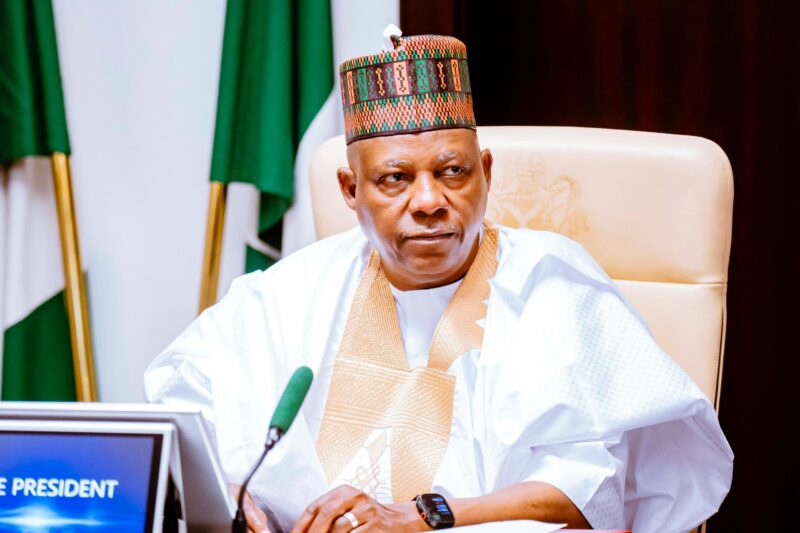
Vice President Kashim Shettima, has called for collaborative and diversified funding models for the Nigerian education sector, which would involve the private sector, alumni, and local communities.
Mr Shettima, represented by his Special Adviser on General Duties, Aliyu Modibo, made the call in his remarks at opening of a two-day 2025 Nigeria Education Forum in Abuja on Tuesday.


The event was organised by the Nigeria Governors’ Forum (NGF), the Federal Ministry of Education, the Committee of States’ Commissioners of Education in Nigeria, and partner organisations.
Describing education as the ultimate foundation of national stability and progress, Mr Shettima said that its financing burden could no longer rest on the government alone.
He said the country can no longer depend exclusively on traditional models of government-only funding.
He said there is no doubt that the country must transition towards a system that is collaborative, innovative, and resilient.

“The theme of this year’s forum, ‘Pathways to Sustainable Education Financing: Developing a Synergy Between Town and Gown,’ compels us to rethink the very foundation of our educational ecosystem,” he said.
“Our needs have grown from classrooms to laboratories, from basic literacy to digital competence, from theoretical instruction to industry-aligned skills.”
He said these needs demand a diversified and sustainable financing model, one robust enough to carry the aspirations of a new generation.
Mr Shettima highlighted President Bola Tinubu-led administration’s clear commitment to increasing education financing over the past three years.
He noted that the administration’s allocation for Education rose significantly under the Renewed Hope plan from N1.54 trillion in year 2023 to N2.18 trillion in 2024 and N3.52 trillion in 2025.
He added that the government also strengthened this investment through key agencies, adding that Tertiary Education Trust Fund (TETFund) budget grew from N320.3 billion in 2023 to N683.4 billion in 2024, and now to N1.6 trillion in 2025.
“The Universal Basic Education Commission (UBEC) has expanded its reach. 25 states and the FCT have accessed N92.4 billion in matching grants,” he said.
“Another N19 billion has supported teacher development in 32 states and the FCT.
“A further N1.5 billion has reached more than 1,147 communities. UBE grants also increased from about N1.3 billion to over N3.3 billion per state, allowing each state to access more than N6.6 billion through counterpart funding.
“Nigerian Education Loan Fund (NELFUND) has opened new doors of opportunity. Created under the Student Loans Act of 2024, it has disbursed N86.3 billion to over 450,000 students in 218 tertiary institutions.”
He said this Fund signals a new era where no Nigerian is denied tertiary education for lack of money.
He called on all stakeholders including the private sector actors, industry leaders, alumni networks, philanthropists, and communities to co-invest in laboratories, research centres, vocational hubs, innovation clusters, and endowment funds.
Mr Shettima said that since education begins in the community, local governments and traditional institutions must take responsibility for infrastructure development, school maintenance, security, and teacher welfare.
READ ALSO: Senate summons finance, education ministers over collapse of $30m Safe School Initiative
He also called on industries to work closely with tertiary and vocational institutions to shape curricula that reflected real labour-market needs.
“Our universities, in turn, must cultivate a sustainable endowment culture, mobilise alumni support, and establish professorial chairs that strengthen academic excellence and global competitiveness,” he added.
The vice president said that the millions of out-of-school children represented a national emergency that required unified action from the federal, states, and local governments, as well as community stakeholders.
Mr Shettima added that teachers must enjoy adequate training, welfare, and professional recognition if they are to deliver the outcomes Nigerian children deserved.
“Technical and vocational training must be scaled up to equip our young people with marketable skills and reduce socioeconomic vulnerability.
“All these interventions require financing that is predictable, diversified, and sustained,’’ he said. (NAN)