
Sub-Saharan Africa’s instability worsened in 2025, with East Africa emerging as the most volatile region, driven by democratic backsliding, violent conflicts and economic fragility, according to the newly released 2025 Africa Country Instability Risk Index (ACIRI) by SBM Intelligence.
The report says East Africa’s risk score jumped from 50.7 in 2024 to 56.0 in 2025, making it “the least performing of the four regions examined”.
The index, which reviewed 48 Sub-Saharan African countries, warns that the region’s widening instability is now shaped by entrenched juntas, coup attempts, civil wars, and the erosion of democratic norms, with SBM noting that the continent’s “increasing flirtation with democratic backsliding” will likely drive 2026 instability even higher.
Youth protests, coups, and crackdowns fuel rising instability
One of the most striking findings is the surge in political instability linked to protests, authoritarianism, and security failures.
The report identifies Madagascar as the continent’s biggest loser, where youth-led protests over corruption and power shortages toppled the government, forcing President Andry Rajoelina to resign and be replaced by the military’s Col. Michael Randrianirina.
ACIRI notes that “Madagascar’s risk score increased by 10 points from 40 in 2024 to 50 in 2025”, driven by the turmoil and a subsequent fragile transition.
Tanzania’s risk score worsened sharply after what the report describes as “a muzzling of democratic institutions and freedoms by President Samia Suluhu Hassan”, noting that her controversial 98% re-election result “increased its risk score to 33 from its previous high of 24”.
Read also: What Guinea-Bissau military takeover means for Nigeria
Sudan, CAR, and Sahel juntas dominate Africa’s top-risk countries
For the second year running, Sudan is ranked the most unstable country in Africa as its civil war deepens, while the Central African Republic, Burkina Faso, Eritrea, Niger, and Mali complete the top tier of extremely high-risk states.
According to ACIRI, 40% of the top ten riskiest nations are in East Africa, while another 30% are Sahelian countries engulfed by coups and jihadist violence. The report notes: “There are no countries in the top 10 from Southern Africa.”
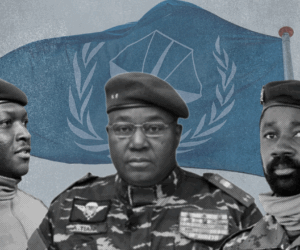
The Sahel in particular remains defined by military rule. Niger formally entrenched junta power in March, with the new charter dissolving political parties and granting coup leaders full amnesty. ACIRI describes this as “the regime’s clear intention to prolong military rule”.
Southern Africa remains the most stable region
In contrast, Southern Africa retained its position as the region’s most stable bloc, posting an average score of 35.25, with countries such as Mauritius, Lesotho, Namibia, Botswana, and South Africa contributing to steady governance. “For the second year running, Southern Africa retained its spot as the most stable region,” the index states.
Notably, Seychelles was the most improved country in East Africa, one of the few bright spots, after a credit-rating upgrade and stronger tourism-driven recovery.
West Africa: Coup rumours, economic strain, and mixed recoveries
West Africa recorded a regional average of 45.2, slightly worse than the previous year. The report highlights Nigeria’s 2025 scare after “September rumours of a coup involving 16 detained officers”, stressing that President Bola Tinubu’s military reshuffle only “eased immediate alarms while revealing deeper strains” linked to economic hardship and widespread insecurity.
Despite this, Nigeria’s score improved slightly, from 55 to 52, due to easing inflation and a stabilising currency.
“Inflation has been declining… the naira is stabilising… and investor confidence has improved,” the report noted.
Senegal, meanwhile, posted one of the strongest improvements after the end of the long-running Casamance conflict, with projected economic growth of 10% in 2025.
Central Africa: Elections, mercenaries, and regional wars
Central Africa averaged 55.75, driven largely by the M23 conflict in eastern DRC, Chad’s involvement in Sudan’s war, and Cameroon’s political crisis. The report says Biya’s eighth-term re-election “ignited large-scale protests… met by a militarised crackdown” and worsened the country’s governance score.
The Central African Republic, heavily reliant on Russian mercenaries, remains one of Africa’s most fragile states, with ACIRI emphasising “enormous humanitarian needs, massive displacement, and deep political uncertainty.”
Overall, Sub-Saharan Africa’s average risk score now stands at 47.46, up from 45.63 the previous year. ACIRI concludes that while 31 countries improved, many of the core challenges, including coups, contested elections, economic shocks, and cross-border insurgencies, continue to worsen.
The report warns ominously that many threats “are likely to remain, and from a security standpoint, likely to get worse, especially if JNIM succeeds in toppling the junta in Bamako.”