From Eli Six30, a young Ghanaian musician; to Jiire Smith, an Abu Dhabi-based youthful Nigerian musician; Mohamed Yahyaoui, a Moroccan musician, and to Onkabetse John Hlongwane, from South Africa, as well as poetic offering from a Ghanaian spoken word artist, the maiden edition of Creative Connect Afrika, lived up to its much-anticipated excitement offering.
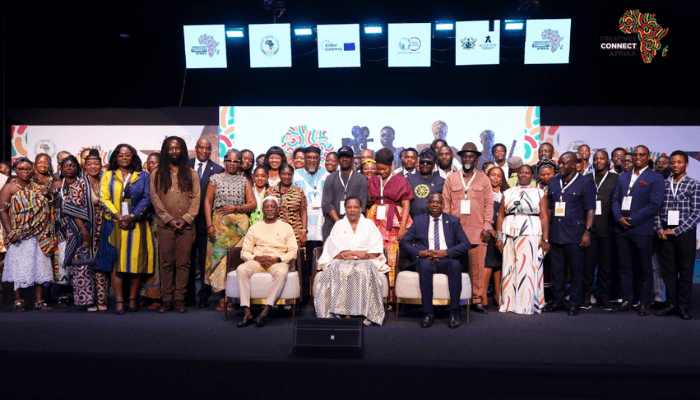
Of course, African culture was equally on display with well-curated dance and music performances from cultural troupes, amid generous showcases of native attires. The three-day event, which held at La Palms Beach Resort, Accra, Ghana, can be summarised as a show of the continent’s best; in colour, creative talent, culture, as well as the best brains to discuss and proffer solutions for more viable and connected African creative, culture and tourism industries.
Yet, the delegates witnessed a first-of-its-kind dedicated African fashion runway, which delivered a striking visual narrative of the continent’s identity, innovation, and creative prowess.
“This is breathtaking,” a delegate said on seeing designs made from local fabrics on the runway. “We need to scale this up, the world will see us differently with these designs,” another delegate enthused from the midst of an excited and cheerful crowd.
Following the above, the job of Emily Mburu-Ndoria, director, Trade in Services, investment, Intellectual Property Rights & Digital Trade (DTIID), AfCFTA Secretariat, Ghana, was done, as she reflected this in her opening remarks at the three-day event.
“Creative Connect Afrika is all about connecting all of us, learning from each other, exchanging ideas, improving on our skills, and impacting our economies and people better,” Mburu-Ndoria said.
According to the Kenyan national, it is all about an efficient platform, a single marketplace, an all-embracing continent-wide hub for talent, practitioners, promoters, stakeholders and even the governments to meet, connect and grow the creative, culture and tourism industries that hold great potential for socio-economic development of the continent.
Considering the huge potential in the creative sector, she insisted that Africa can lead the world with her talented creatives, convert her intangible assets to tangible investments, create jobs, empower the people and boost her economies. But the above can only be possible when the industries are connected, when there is a common platform and harmonized business and operational policy framework for the creative industry.
Read also: Oreoluwa Alayande wins 2025 MTN mPulse Spelling Bee, emerges MTN CEO for a day
“These are why AfCFTA is relevant. We created the Creative Connect Afrika as a vehicle to achieve the above,” she said.
Wamkele Mene, secretary-general, AfCFTA Secretariat, in his remarks at the opening ceremony of the event, highlighted the huge potential across the country that needs to be harnessed for the development of the green economy and better life for the people.
“We convene today to acknowledge the vast potential of Africa in these domains and to transform our commitments under the African Continental Free Trade Area (AfCFTA) into tangible investments and employment opportunities,” Mene said.
Describing the creative industries as fundamental drivers of economic transformation, the AfCFTA secretary general noted that, “Creatives Connect Africa 2025 is focused on the film, music, and fashion sectors, which exemplify our creative capabilities and entrepreneurial spirit. These industries are essential for socio-economic development and cultural exchange. The success of Africa’s creative sectors, particularly through platforms such as TikTok and YouTube, illustrates the potential for enhancing intra-African trade and generating employment”.
The event also had the support of the Ghanaian government, which had been intentional at developing the creative, culture and tourism industries, especially with the creation of the Black Star Experience under the office of President John Mahama.
In his remarks at the event, President Mahama, who was represented by Rex Owusu Marfo, coordinator, Black Star Experience, Ghana, reiterated the efforts of the government at making the creative, culture and tourism industries count in the economy of the country, while noting that Creative Connect Afrika aligned with Black Star Experience mandate, which is “to position Ghana as Africa’s leading cultural, tourism, and creative hub, blend cultural diplomacy, creative industry development, and nation branding and amplify Ghana’s unique identity on the global stage”.
For Marfo, AfCFTA’s Creative Connect Afrika is one of the high-impact platforms and partnerships across the arts, music, fashion, film, and tourism sectors that will enable the Black Star Experience to tell Ghana’s story in compelling ways that resonate with both local and international audiences.
Toeing the same line of Marfo, Kwakye Donkor, CEO, African Tourism Partners (ATP), one of the organisers of the event, noted that Africa has so much to export to the world, from her compelling stories championed by the movie industries of Nollywood, Ghallywood, South Africa, and East Africa filmmakers as well as her music; Afrobeats, Amabiano and highlife and to fashion brands that on global runways in New York, Paris, London, among others.
He noted that the Creative Connect Africa is offering a platform for better coordination of the industries, upscaling of talent and creators, optimal harnessing of the potential, and especially fostering a unified voice and front for the empowerment of African creatives starting from the continent to the rest of the world.
He insisted that collaboration is key to harness Africa’s huge potential in the creative, culture and tourism industries, while urging all the creative entrepreneurs, delegates and speakers at the event to consolidate on the collaboration they formed at the Creative Connect Afrika 2025.
“I like to see Ghanaian music artistes doing collaborations with South African musicians; Kenyan filmmakers co-producing films with Nigerian filmmakers; Gabonese fashion designers collaborating with Botswana or Moroccan designers. This is the essence of our gathering in Accra for these three days and it should be a waste,” Donkor charged the delegates.
Moreover, the masterclasses, which are core of the event, were worth participating in as experts across the creative, culture and tourism industries highlighted challenges, as well as feats in the industries, amid trends, insights and call to action.
In ‘Facilitating Mobility for Tourism, Cultural and Creative Professionals’, one of the many panel discussions across the three days, the panelists had a robust discussion on mobility, which is one of the continent’s biggest constraints, dissecting its multidimensional nature, from visa challenges to air connectivity, road and sea travel, and digital access.
They also drew urgent attention to restrictive visa regimes that limit collaboration and commercial opportunity as well as high intra-African flight costs affecting tours, festivals, and film production.
Also, digital mobility gaps that slow cross-border content production and distribution, need for harmonised policies under AfCFTA to create a seamless creative marketplace and calls for coordinated political will, enhanced bilateral agreements, and public–private mobility frameworks that finally allow creatives to move freely across Africa were recommended.
Another interesting panel was the one on ‘Financing Africa’s Creative Businesses’, which allowed the speakers to explore the evolving financial models and instruments needed to support the growth of the continent’s creative industries.
They highlighted the necessity of blended financing models to support creative enterprises, building sustainable enterprise development programmes and creative hubs, strengthening financial literacy within the creative sector, encouraging private–public partnerships to de-risk investment and emphasising export-readiness and proper governance structures.
The expert panelists also insisted that that financing is not only a capital issue, but a structural one that requires deeper integration between financial institutions and creative entrepreneurs.
They enjoyed attention from the audience as the speakers answered questions and cleared the air on finance, recommending self-sustaining funding models and well-structured models.
The panel on Intellectual Property (IP) nailed the discussion on funding, highlighting the need to properly legalise and formalize creative ideas and products.
According to them, it would enable creatives to leverage intellectual property libraries for securitization, building valuation tools that financial institutions recognize.
“A well-documented IP is an asset and it enhances one’s bankability,” one said. Another insisted that, “Formalising creative enterprises will attract long-term investment for a conscious and ambitious creative”.
However, they called for the harmonisation of IP across Africa for better structure and to unlock the value of Africa’s creative IP, which they said is a goldmine.
Another panel tagged ‘Fashion Runway: A bold celebration of African creativity’ was insightful too. In her insightful opening, Makeba Boateng, convenor, Fashion Africa Forum, noted that fashion is not merely aesthetic expression, but also a competitive creative industry with tangible economic impact across manufacturing, retail, tourism, and global branding.
Boateng and other fashion designers at the panel offered reasons Africa should look inward to develop her fabrics to boost access to raw materials and be less dependent on China.
Still in fashion, the Creative Connect Afrika had what everyone agreed was their highlight event, the Africa Runway Show on the last day.
On the runway were models showcasing culture-inspired couture, infused with traditional textiles and motifs by designers from Ghana, Nigeria, South Africa, Gabon, Kenya and other countries presented collections that moved effortlessly between heritage and futurism.
However, the Creative Connect Afrika 2025 was wrapped on an inspiring note, amid music performances, cultural shows and transformative dialogue, collaboration, and marketplace
Engagement formed as Africa’s leading policymakers, creative entrepreneurs, investors, and cultural thought-leaders present at the event.
A well-curated show tagged Accra By Night was the spice for many, allowing them to explore the beauty of the Ghanaian capital city at night.
Big thanks go to Samuel Agyeman, the programme director for the three days, AfCFTA, ATP and Black Star Experience for partnering to successfully deliver on the first-of-its-kind event.