A high-level bipartisan delegation from the United States Congress is conducting a strategic visit to Nigeria, aiming to assess security challenges and bilateral cooperation first-hand. The visit follows deeply divisive rhetoric in Washington concerning alleged religious persecution in Africa’s most populous nation.
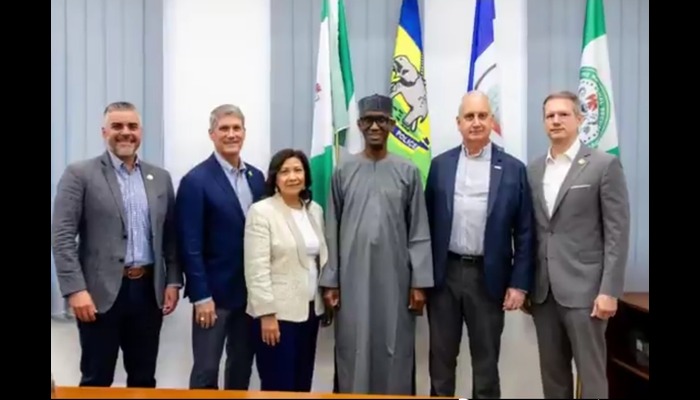
Nuhu Ribadu, the national security adviser confirmed the delegation’s presence on Sunday, stating that the engagement follows prior high-level talks in Washington, D.C., on shared security priorities. The group includes Representatives Mario Díaz-Balart, Norma Torres, Scott Franklin, Juan Ciscomani, and Riley Moore, accompanied by Richard Mills, the U.S. Ambassador to Nigeria.
Official discussions in Abuja focused on “counter-terrorism cooperation, regional stability, and strengthening Nigeria–U.S. strategic security partnership,” according to a statement from Ribadu. He expressed optimism that the dialogue would “deepen trust, collaboration, and shared commitment to peace and security.”
Congressman Riley Moore extended the visit’s scope beyond the capital, travelling to Benue State in Nigeria’s volatile Middle Belt region. There, he met with local Christian leaders, including Wilfred Anagbe and Isaac Dugu, the bishops of Makurdi and Katsina-Ala, and the Tor Tiv, the paramount traditional ruler.
“I came to Nigeria in the name of the Lord and on behalf of the American people,” Moore stated, calling the meetings “very productive.”

How it started
The mission is set against a volatile political backdrop in the United States, after Donald Trump, the U.S president repeatedly and forcefully accused Nigeria of permitting a “Christian genocide,” a designation that prompted his administration to label Nigeria a “Country of Particular Concern” in November and float the possibility of unilateral military action.
These accusations exposed a sharp partisan divide within the U.S. Congress. While some lawmakers, particularly on the right, amplified the genocide narrative, others urged caution, emphasising the complexity of Nigeria’s interwoven security crises involving militant Islamist groups, rampant banditry, and endemic communal violence. This delegation’s task is to cut through the political rhetoric with ground-level evidence.
Reports of US surveillance
Meanwhile, independent security analysts have reported a surge in U.S. surveillance operations over Nigerian airspace. Conflict reporter Brant Phillip has detailed flights by U.S. reconnaissance aircraft over southwestern states such as Kwara and Ekiti, suggesting an intensified intelligence-gathering effort potentially linked to the political visit.
Read also: Trump’s threat of military action in Nigeria triggers outrage in US Congress
This combination of overt diplomatic engagement and reported covert surveillance underscores the multifaceted and high-priority approach Washington is taking towards Nigeria’s security situation. The Congressional delegation’s findings are likely to directly inform a deeply fractured U.S. policy debate, shaping whether America’s response leans further toward forceful intervention or reinforced bilateral partnership.