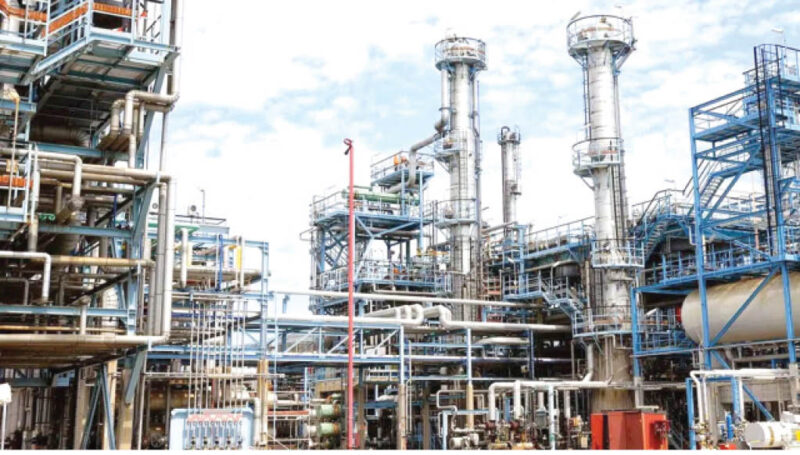
As the Nigerian National Petroleum Company Limited (NNPCL) remains undecided on what becomes of the country’s refineries, experts have advised the government to sell the refineries instead of engaging in needless rehabilitation.
It would be recalled that the federal government under former President Muhammadu Buhari had spent $3.7bn rehabilitating the refineries from 2015 to 2022.
The Port Harcourt refinery got $1.5bn (N2.1tr in 2025), Warri refinery got $900m (N1.2trn in 2025) and Kaduna refinery got $1.3bn.
SPONSOR AD
While none of the rehabilitation projects was completed under his tenure, the Port Harcourt Refinery was said to be completed in December 2024 and it was operational till May 2025.
But upon his assumption, the Group Chief Executive Officer of the NNPCL, Bashir Bayo Ojulari, had mulled the sale of the refineries.
Ojulari had in July said the sale of the country’s crude oil refineries was not ‘off the table’, disclosing that the rehabilitation of the facilities had become more complex than expected.
Speaking during the 9th OPEC International Seminar in Vienna, Austria, Ojulari revealed that the technologies imported to fix the facilities are largely misaligned with the refineries as a result of old age.
Ojulari said: “So our refineries, we made quite a lot of investment over the last several years and brought in a lot of technologies. We’ve been challenged. Some of those technologies have not worked as we expected so far. But also, as you know, when you’re refining (rehabilitating) a very old refinery that has been abandoned for some time, what we’re finding is that it’s becoming a little bit more complicated. So, we’re reviewing all our refinery strategies now.
But four months later, the GCEO said there is a new plan to rejig the refineries to produce internationally accepted high-grade petroleum products.
Speaking during a press briefing last week, Ojulari said the current capacity of the refineries makes it difficult to produce high grade petroleum products.
He said the company, having transited to a limited liability company, is now positioned to make sure the refineries are operational when they are profitable and sustainable.
“If we go by the original plan, let’s just assume we just go ahead with the completion timeline set by the previous board, by the time we finish the ongoing rehabilitation, the products from those refineries will be far lower in standard than the Dangote refinery and then two-step lower in standard by the current international specifications.
“That is not what we want to be designed but that of high grade so that the petroleum products we produce will be of international standard and we will have a good commercial market rate.”
On how the refineries will be rehabilitated, he said the company will go into a profitable contract with reputable companies that currently operate a refinery to measure their level of competence.
“The PIA already creates an environment where NNPCL is able to consummate a commercial agreement and commercial entity than ever before. If you look at the Dangote Refinery, you will see that most people running it are foreigners. We need to review our policies as we have lost that capacity of attraction overtime. So, what we are looking for is some partnership with private entities.
“These private entities must have existing refineries that they are running, so, you don’t just by mouth, so they must have that track record and our intention is to partner with them as a business. It will be a commercial agreement where they bring in technical capacity, technical resources and all of that and we complement it with the ability we have and we cooperate but they will lead the operation because we want people who are still in the game.”
Investment in refineries hit 2.92 trn in 2024
Daily Trust reports that the NNPC had increased its investment in the three refineries to N2.92tn in 2024, even though the facilities have yet to resume steady production after years of rehabilitation delays and repeated shifts in government timelines.
According to the company’s audited 2024 financial statements, total investments in the Port Harcourt, Kaduna, and Warri refineries rose from N1.72tn in 2023 to N2.92tn in 2024.
This represents an increase of N1.196tn or 69.5 per cent within one year. The data appear under investment in subsidiaries in the company’s separate financial statements.
Investment in Port Harcourt Refining Company increased from N674.32bn in 2023 to N1.143tn in 2024. This is a rise of N469.16bn, which amounts to 69.6 per cent. Kaduna Refining and Petrochemical Company saw investment increase from N641.71bn to N1.088tn, a rise of N446.48bn, or 69.6 per cent. Warri Refining and Petrochemical Company also recorded an increase in investment from N402.96bn to N683.33bn, an increase of N280.37bn, or 69.6 per cent.
NNPCL should sell refineries
Speaking with Daily Trust, Oil and gas governance expert, Mr. Henry Adigun, said the NNPCL should take the advice of selling the refinery as its value continues to depreciate.
“No, my picture is that the refineries should be sold. Whoever is buying it might not want to pay that much because when I look at the balance sheet, I say, well, the balance sheet is not very high and therefore, I think it will pay less. So, it’s just a different kind of concept between value and profitability.
“For me, these assets look dead as they are assets that cannot function under optimal conditions with its current ownership structure. The more the NNPCL holds on to the refineries, the more obsolete they become. If NNPCL is wise, it would get the assets out of their books immediately because they are getting through functional obsolescence as time goes on.”
He added that the option of giving it to private investors might not work, stating the decision rests solely with the federal government.
He stressed the need for the company to be free from government’s interference and the board should be allowed to make decisions that will attract investments.
On his part, a renowned professor of petroleum economics, Prof. Wumi Iledare said state ownership of the refineries has failed.
“NNPCL is now a commercial company under the PIA. Holding 100% of these refineries contradicts that mandate. The smarter path is to sell them or give majority control to competent private operators through a transparent, competitive process.
“This shifts the operational and financial risk to people who can actually run refineries. It frees cash for debt reduction and strategic investments—especially gas and midstream, boosts investor confidence in NNPCL and it gets refinery output restored faster.”
He added that selling the refineries does not mean losing national interest as Nigeria can protect itself with proper valuation, open bidding, strong local content rules, social safeguards, and a minority/golden-share if necessary.
“Clinging to full ownership has cost us enough. Selling with smart safeguards is the commercially sensible way forward,” he added.
As a Nigerian living here or in the diaspora, DO YOU HAVE A PLAN B? Just in case anything goes wrong, is there a side business you can fall back on? We show you step by step how you too can start earning US Dollars consistently. Nigerians can now make as much as $20,000 to $35,000 with premium domains. Ideal for business owners, entrepreneurs, and workers.
Click here to find out how it works