1
…Experts See NGX Growing From Around 20% Of GDP To 80%
…Say Listings Would Reset Nigeria’s Investment Narrative
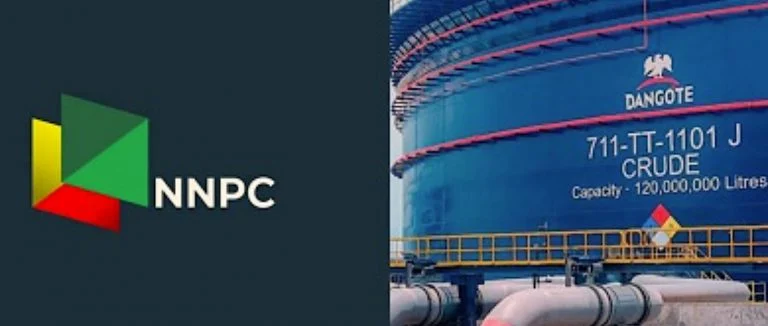
LAGOS – Nigeria’s capital market is on the verge of a potentially historic transformation as strong momentum builds around the possible 2026 stock market listings of Dangote Refinery and the Nigerian National Petroleum Company Limited (NNPCL).
Analysts say the anticipated dual listing would radically expand the Nigerian Exchange (NGX), attract unprecedented liquidity, and significantly advance President Bola Tinubu’s drive toward a $1 trillion economy.
The expectations intensified after Bismarck Rewane, Managing Director of Financial Derivatives Company Ltd., projected that both companies could join the NGX as early as next year. His view is reinforced by broad analyst consensus that a Dangote–NNPCL listing wave would be the most consequential financial milestone in Nigeria in two decades.
While the projections remain contingent on operational and regulatory readiness, experts insist the scale and impact of such listings would fundamentally alter Nigeria’s economic and market trajectory.
Central to this outlook is the size of the companies. Dangote Refinery, valued at about $32 billion, is the world’s largest single-train refinery with the capacity to refine up to 650,000 barrels per day.
NNPCL, with upstream, midstream, downstream and gas assets valued informally between $30 billion and $60 billion, remains the country’s most strategic national asset.
The entry of both giants could push the NGX’s total capitalisation to levels never previously imagined.
Rewane argued that with new entrants such as the $32 billion Dangote Refinery and a potential NNPCL listing, Nigeria’s stock market could grow from around 20 percent of GDP to nearly 80 percent in the medium term—a leap that would transform the exchange into a dominant engine of capital formation and long-term investment.
This single projection, analysts say, highlights the scale of change possible within the market’s structure if the listings materialise.
Market experts agree that a partial listing of Dangote Refinery—perhaps 10 to 20 percent— would unlock billions of dollars instantly into the NGX. Coupled with an NNPCL public float, it would deliver the biggest liquidity injection in Nigerian market history.
“It would be like MTN, Airtel, Seplat and the banks coming at once,” said Modupe Fabamise, a capital markets lecturer at the University of Lagos. “This is a structural shift, not a routine listing.”
The dual listing is also expected to attract significant foreign portfolio investment. Global funds that exited Nigeria due to FX restrictions and liquidity shortages may return if large, globally recognised entities become available.
According to Kole Aluko, portfolio manager at TopBridge Asset Management, “Foreign investors want scale, depth and transparency. The listings of these national champions would immediately reset Nigeria’s investment narrative.”
Analysts also argue that the potential listings align perfectly with the Tinubu administration’s economic reforms, especially efforts to unlock private capital, deepen industrial output and diversify foreign exchange earnings.
The operational ramp-up of Dangote Refinery is already expected to reduce Nigeria’s dependence on imported fuel, grow petrochemical exports and improve the country’s external accounts. NNPCL, on its part, has been making incremental moves toward better transparency, publishing audited accounts and attempting to operate more like a commercially driven entity.
Economists say the listings could strongly support the government’s $1 trillion GDP ambition by expanding the financial system’s capacity to fund large-scale investments. By unlocking public participation in energy, refining, petrochemicals and gas assets, the listings would expand local wealth creation and boost tax and dividend flows to government.
More importantly, they would reposition the NGX as a central pillar of Nigeria’s growth strategy, similar to how major state and private corporations fuelled capital markets in South Africa, Saudi Arabia and Indonesia.
For ordinary Nigerians, the benefits are equally significant. A public listing of NNPCL would, for the first time, allow citizens to own shares in the country’s most strategic oil assets.
Analysts liken it to Saudi Aramco’s 2019 IPO, which became a national investment milestone.
“This will democratise wealth creation,” noted Fabamise. “It gives every Nigerian a chance to benefit from national assets traditionally outside public reach.”
Market participants compare the potential impact to the landmark 2005 banking consolidation—but insist it would be far bigger.
According to Oseme Okon, an investment banking expert at Vector Securities, “Bank consolidation redefined the financial sector. This will redefine the entire economy because it shifts Nigeria’s market from being bank-heavy to energy-and-industry-heavy.”
Still, there are notable challenges. For NNPCL, analysts insist that improved governance, resolution of legacy liabilities, and transparent financial reporting are essential before a listing.
Dangote Refinery must demonstrate stable output, consistent supply chain operations and predictable cash flows. Market conditions such as exchange rate volatility, inflation and interest rate dynamics could also shape the timing of the offerings. Political will—especially for a partial privatisation of NNPCL—remains another key factor.
Despite the risks, analysts believe 2026 is realistic. The ongoing FX reforms, banking recapitalisation, expected macroeconomic stabilisation and increasing appetite from both retail and institutional investors create a favourable backdrop for mega listings. “2026 gives both entities enough time to finalise valuation frameworks, governance structures, board reforms and regulatory documentation,” said Samuel Adigun, senior analyst at Afrinvest Research.
If realised, the listings may push the NGX toward a historic milestone of N100 trillion market capitalisation, making it one of Africa’s largest and most liquid exchanges. Oil and gas—currently underweighted on the NGX—would overnight become its dominant sector. Retail participation would surge, institutional portfolios would rebalance, and Nigeria’s regional influence within African capital markets would strengthen, potentially challenging South Africa’s Johannesburg Stock Exchange.
In essence, the possible entry of Dangote Refinery and NNPCL in 2026 represents more than a financial event; it offers Nigeria a rare opportunity to reshape its market structure, deepen investment capacity and accelerate national economic reforms.
By potentially pushing market capitalisation from 20 percent of GDP to nearly 80 percent, the NGX is positioned for a once-in-a-generation structural leap.
As analysts widely agree, if both listings proceed, 2026 may be remembered as the year Nigeria’s capital market finally stepped into a new era—bigger, deeper, more liquid, and central to the country’s journey toward a trillion-dollar economy.