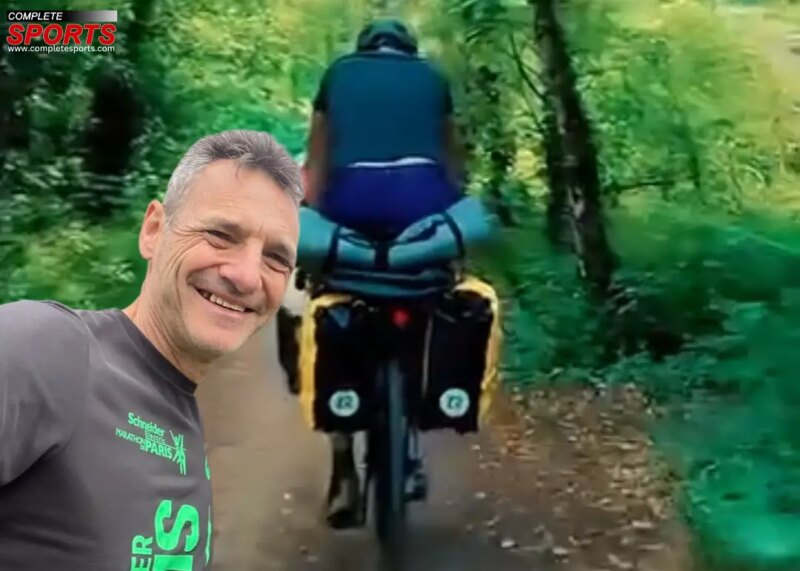
For me, the problem was that I told nobody, I kept it a secret until a year ago. So for 43 years, I kept it a secret and I thought I could deal with it alone and I couldn’t; it ate me up from inside and that’s what I’m doing now. I’m dealing with that past and I’m trying to deal with it in a healthy way.
And the more I share, what is incredible is I’m finding more people actually helping me recover as I’m helping them. People open up to me and we talk in the background and private numerous people that follow me publicly and then they get hold of me privately and we talk privately and we share and we help each other.
So this journey has absolutely surpassed my expectations with how it has helped me in the way of recovery. So, I’m writing a book about my life, which is something I will do throughout the process of my travels, but if it is healing and doing and it’s working and it’s doing exactly what I wanted it to do and the next big part of it is meeting people and learning about different cultures and traditions and just the way different countries work because I think, for very long, people think the Western world and America Europe and UK are perfect. But when it comes to communities, families and sharing and talking and knowing your neighbour, West Africa to me, has been streets ahead of where we are back in England or Europe where people don’t know their neighbours. Here, people know their neighbour and the kindness from strangers. People will stop me on the road and share a meal with me and invite me and let me stay in their homes.
So, I feel very privileged and honoured to be invited in and experienced that which I think very few people do, so that is the second part of my journey. No matter how much you got in the world, connection with people; the real connection is huge.
You are a citizen of which country?
I am a South African; born and bred, and eight years ago, I moved to the UK, so I hold dual citizenship.
At what time did you conceive the idea that it was possible and what convinced you that you could actually cycle from London to Cape Town and now you’re in Nigeria?
You know it is a funny thing. I’ve always been somebody who sets goals and sets out to achieve them and my philosophy in life is ‘Set your goal and then don’t look at the end goal.
Too overwhelming and too far and if I sat and I thought about 17,000 kilometers and how am I gonna do that, I don’t know if I ever would. So, I knew I needed the challenge and I looked at various challenges.
I looked at walking. I looked at going on a motorbike. I looked at all sorts of options and the bicycle resonated with me. It was something that I really liked and I wanted to do and I thought I could cover enough ground.
But to get over that ability of actually achieving that goal, for me, all I worry about is today and tomorrow and if I can achieve what I need to achieve tomorrow, sorry today, I know that I can do it tomorrow.
I don’t worry about months or the eight months that I’m on the road. I just cannot do. So I average between 100 and 150 kilometers a day when I’m cycling, so can I do 50 kilometers? Yes, I can do that.
And at the end of the day, I get off my bicycle and I sort of think ‘Okay, I can do that again tomorrow’ and I sit out and I do it. So I think it’s setting a goal and then tripping away that slowly, slowly, slowly and then you look back and you’d like now I look back and I sort of think well I’ve done 10,000 kilometres and I’m halfway. Cape Town now does not feel so far away for me.
How did you deal with fatigue on the way; how did you cope?
Listen, there are days when I shout at the universe and I scream and it’s hard and you really have to push yourself and coming through Spain and going over the Pyrenees Mountains, huge climbs.
Yes, my legs burnt and they were painful and it was tiring and I think personally, I’m of that character where I don’t give up, I just put my head down and I just keep going and It’s not easy; there are days when you want to stop.
These days when I sit on the side of the road and I cry, the days when I want to give up and throw in the towel, absolutely, but again, you know when I do stop that day and I sort of think about it and I sort of have my chance to sort of regain and regroup and get my energy back. I wake up the next morning and I sort of think ‘Okay, today’s not gonna be as bad as yesterday. Let me go, let me go again’.
It takes grit, determination and courage, but it is doable and the longer I’m on the journey, obviously the easier it becomes. The first month is probably the toughest because your body is getting used to the change and (9:20) Adapting to what you do on a daily basis.
Six months in now, the body is, the right muscles are strong and so forth, and you have challenges. I mean, I’ve had a serious accident while riding and you’ve got to deal with it, So I think being a solo-rider is probably more challenging than the distance and everything else because when you’re on your own, you don’t have a friend to pat you on the back and say ‘Come on I know it’s tough’. You know one person’s positive and the other one’s negative. It is just you and you’ve got to talk yourself through, so I think you got it from character strong mind and just push through.
So it took you six months to get to Lagos from London?
Yes, that’s right.
How many continents or countries did you cycle through before arriving in Lagos?
It’s been 14 countries: France, Spain, Morocco, Namibia, Senegal, Guinea-Bissau, Guinea, Sierra Leone, Liberia, Cote d’Ivoire, Ghana, Togo, Benin Republic and Nigeria.
So basically, it’s just Europe and Africa?
At the moment, Europe and Africa, going along the West Coast down to South Africa and when I get to South Africa, I’m going to do the East Coast and then go back to Egypt.
Were you planning to set a record or attempting to break any Guinness World Record when you set out to do this or you were just doing it to overcome those personal struggles?
I set out for my personal struggles; I’m not the first person to be doing something like this. I’m not trying to race it and, so when I find places where I feel I need to stay longer and I am doing work with schools, cycling clubs and things along the way, so where I feel people need me, I stay a little bit longer. So I’m definitely not racing it, I don’t ride every single day if I find that there’s a need for me to hang around a little bit longer than I do.
So it’s personal, for me. It’s personal and sometimes, I feel quite, I don’t know If I’m selfish because of the wealth of goodness that I’m getting out of people and how much they’re sharing with me, is making me as a person and I almost feel guilty for that because it’s more people should be able to to have it, but they’re not — nobody’s gonna, so many people aren’t gonna get it because you got to work hard.
You put yourself into the situation where you are vulnerable and you are available and you are there to talk to people and I’m loving my access to young children and sports and getting young kids onto bicycles. So wherever I get that opportunity, I spend time with cycling clubs, cycling teams, trying to get young kids back to school and continue their education but find a passion that they’ve got something to love.
So along the way, you were still impacting people and humanity?
100%. I want to give back, I want to help. I find it very difficult because I’m not sure how to do it because I’ve got to fund myself and you know keep myself going and every time I stop it costs me extra, but I do help, and I do find that my followers contribute.
So we had five children in Sierra Leone who the week before last week we put back into school for a year. We paid for their school fees for 12 months and cycling so those five children are back at school and I’m talking to the older kids to see how we can help them further their studies, looking at university stage.
I’m working with two cycling clubs in Sierra Leone, one or two in Ghana; one in Accra and one in Pecky. We are working with developing young kids and getting them off the streets onto bicycles and learning that there’s more to life that if you find a passion and you love this sport and you commit to your sport, you can use that determination, commitment and courage.
You can actually use it in any field, even if you don’t make it in cycling as a professional rider, that ability to get to that level or close to that level you can use those skills to drive yourself forward in any career in any in an aspect of life, and we seeing these kids, the change is unbelievable.
I mean some people have started before I got there, I’m gonna help them speed up the process and where they’re short of money, I’m trying to find the money. I’m fairly well connected worldwide with business and and people around the world, so where I can I draw on my contacts and I sort of sound ‘You know We need a little bit of money’, yeah, we need a bit of money there’ and then I pass that on.
So I would love to give back. I think ultimately one day, when I finish my travels, I will probably come back to West Africa as my place not sure which country, because there is opportunity and so much to give back.
Maybe you should choose Nigeria. Are you planning to establish a cycling club in Nigeria? How long have you been in Nigeria for and how long are you staying on for before continuing your journey?
I don’t establish cycling club; what I do is I work with cycling clubs that are existing. So I would work with any cycling club that is existing and encourage them to bring in young kids. So the focus is to get young children off the street. Give them a bicycle and those clubs take them in. It comes like a family bond, so that’s the part I work on because if we start them young they become good cyclists later on. So, I work with existing clubs and so I would happily work with any cycling clubs in Nigeria.
I only got here the day before yesterday (Thursday) and I’m starting to look now for some cycling clubs. See what I can find, so absolutely, I would love to work with clubs in Nigeria. Most sports actually, it doesn’t have to be cycling. I think any sports that a young person can be involved with and get passionate about is a positive.
So for me, it’s educating; how do we keep children educated and playing sports? I think in Africa, there’s a bit of a problem where and I understand it; I understand the hustle and the need to make money and the need to survive, so when a parent sees a child loving a sport and unable to contribute and maybe work in the family, market store or whatever it might be, how do those parents allow the child to continue riding three, four hours a day and training and so forth.
The parents don’t see them, and they don’t see the future for that child. So It’s difficult to show those children. Kids in the UK and the States in Europe, parents put them in all sorts of extra activities and they want them to do sports and as much as they can. Africa is different. People are working from a young age to help their family and support their family.
So it’s tough, but the kids that get it right and the kids that are doing it fall in love with the sport. They start achieving from a young age.
There is a quick story I’ll tell you. One cycling club I work with in Freetown, they’ve got 27 members, 13 of them off the street, They live with the owner of the club, he’s made a place for them to stay of those 27 this year in October, three of them represented Sierra Leone at the World Championships in Rwanda. That’s the power of what it can do. Two of those kids are now living in Dubai at 26 and 27. They’ve managed to get themselves to Dubai.
They’re working there; they’re cycling there and cycling has become their sport. They are bicycle mechanics, some of them have gone to university, they’ve taken their sport and turned it into something and and I think that’s what I’d love to be part of.
I’d love to work with different clubs around West Africa and develop that within young people get these kids off the street and give them a passion, give them something that they are excited to wake up and go and do every day. I think it would be my ultimate, would be phenomenal.
I’ve got an idea on how to be able to educate children beyond just sports that you can sort of vary the education, not just from school but It’s a long project and it’ll take me years to build it, but ultimately it would be to get back to West Africa. It wouldn’t be one particular country. I don’t think so.
Did anyone ever tell you it was insane when you shared the idea that you wanted to cycle from London to Cape Town?
Everybody! It’s funny. Even today, I was in town today here in Lagos and the bolt driver or I’ll tell the shopkeeper what I’m doing and they’ll go silent and they’ll say, ‘No, stop kidding, tell me the truth’. A lot of people don’t believe you and don’t believe it’s true.
Obviously when they see me on the bicycle, it’s different. But no, I mean I may even think personally of my family, they said ‘What are you doing it for’? Why are you putting yourself through that? And I don’t think they would understand it; I mean as I said for me, this is the two reasons.
The personal reason is a very powerful reason for me, I need to heal and then this is how I’m doing it. The other side of the very fulfilling reason. I’m getting satisfaction and gratification that I’ve been an entrepreneur my whole life, I’ve had businesses that have been hugely successful and other businesses that have failed. I’ve never ever got the satisfaction, that I do when I see a child going back to school or when I see these kids who I’ve met and I’ve spent a couple of weeks with and they text me on their cycle ride, on their training ride, I mean there’s a huge event and they all at the moment and my phone hasn’t stopped today of everything that they’re doing, the satisfaction from that has outweighed any of my business success or anything else. It’s definitely what I want to do going forward. I want to do that more.
I know most of your experiences on this journey have been in Africa. What can you say about Africa, West Africa, the people, the warm, the welcome; what has the feeling been like?
I didn’t actually know what to expect coming to Africa, to be honest. Growing up in Southern Africa, I know South Africa but I’d never been to West Africa. Everybody told me it is warm, hospitable and a friendly place.
I think the sad part is when you look at — like the British government will tell you don’t come and it’s all RED, don’t travel, don’t travel, don’t travel, don’t travel. And it’s sad because I think people need to experience the hospitality, the welcome that you get from the people in West Africa.
I have yet to have a bad experience. Anyway, I haven’t had anybody that’s been rude to me nasty or unkind. The number of people from Morocco all the way through to Nigeria that stop, share, invite me in and make me feel welcome, just has blown me away. I Could have never expected it. I did a post actually as I came into Nigeria. I mean Nigeria is a country where everybody warns you. ‘Nigeria is dangerous, don’t go to Nigeria’. You know, be careful.
I met another cyclists that was sort of cycling around the area and they avoided Nigeria. And I crossed the border between Benin and Nigeria, Seme border, I mean, I haven’t really had a problem at a border post yet. But the friendliness and the helpfulness of the immigration’s offices and the staff at the border post was just amazing. I mean they literally walked me through the process. They didn’t know who I was, not anybody telling them to look after me. They were just incredibly kind and I think I went through 14 roadblocks between the border and Lagos.
I just tell the guys ‘Please I’ve got to carry on cycling’ and they wanted photographs, they wanted to chat, I didn’t get asked for one bribe nobody asks me for money, everybody was just overwhelmingly kind and I was telling BJ today one of the guys that stopped and followed me, he said he’s in Lagos tomorrow, ‘Can he take me out for a beer?’
Officials, they’re normally people you nervous of, so it’s been overwhelmingly surprising how hospitable, how kind and how nice the people are in West Africa generally. I often on my posts will tell people, ‘stop listening, stop reading, come and experience, come and experience. Don’t be stupid, don’t take chances, be aware but come and get to know the people, the food, walk around among people and be open.
I think there’s a lot for us to learn from the African continent in general, I think it’s a very kind place. It’s a harsh place, I think it’s very hard and people work hard and they survive but they also look after their neighbour.
When you arrived in Nigeria, how was the reception like? Were you given a special sort of special reception and how would you describe Nigerians from your experiences?
I do have some Nigerian friends from London but I couldn’t have anticipated what I’ve got. I’ve found that people are incredibly friendly, hospitable and helpful. Since I got here, It’s only been two days but wherever I go, if I’m walking, I normally walk a lot, I don’t like using the vehicles and so forth so wherever I can I’ll try and walk. So I’m on the street. Everybody greets. ‘Hello, sir. How are you?’ Can I help you?’ Yes, you get areas you’ll get the fixes, they want to take you and sell you and so forth, and that’s Africa; they all try to make money.
But generally, if I ask and I’m looking for something, people fall over backwards to come and help you. If you look at my post that I did the other day, It’s exactly what I said. As I said, stop reading the news, come and experience it because it is not what they’re telling you. This is amazing and it’s not the first time I’ve heard it.
There was another traveler that came through and they said exactly the same that Nigerians were just open, welcoming, they wanted you to take their picture, they wanted you to share, they wanted you to be involved and that’s what I found. I found that people are just very, very friendly, very open and very warm. It’s wonderful. It feels happy.
Would you like to be back again in Nigeria?
Absolutely!, It won’t be my last visit; that’s for sure. I’ll definitely be back. I mean Nigeria, I think is a country that there’s so much to see and so much to do. Unfortunately the way I travel, I only get a small sliver of a flavour as I go through and I’ll spend, I’ll probably spend two weeks in Lagos and then it’ll take me about six days to get to Cameroon.
So I’ll have sort of three weeks in total, probably In Nigeria, which I don’t think is enough. I will definitely be back. It seems to be a great country and what I’ve seen so far. I’d like to see more.
So London to Lagos is already in the bag for you, would your next endeavour be Johannesburg to Australia?
No. From Cape Town, I’m turning around and I’m doing the East Coast of Africa. So I’m going all the way up to Cairo. Once I’ve done that, the intention or what I’ve originally planned was to go through Israel. You reckon right around to India, but the war that’s going on there I don’t think I need to go through that country right now. I’ll probably fly to India and then India, Asia, all the way down to Timor East and the idea is to go to Australia and then eventually South America.
So my intention was to ride for the next four to five years and sort of cover maybe a 100,000 kilometres and end off eventually in America ,— in the States.
Thanks for your time.
Thank you for your time and thanks for the interview.