
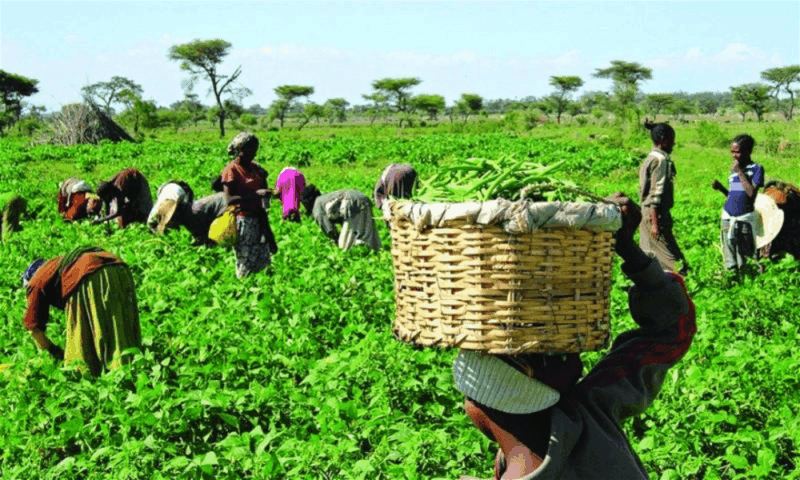
After months of steep and relentless increases in the prices of food, Nigerians are finally seeing a rare relief. Local staples such as maize, beans, yam, cassava and rice are trending downward, easing the pressure on household budgets that have long stretched to breaking point.
But while consumers welcome the breather, another group is grappling with an emerging crisis: the farmers who produced the food.
Across major farming belts and local markets, farmers say the current price crash is wiping out their profits and endangering next year’s planting season. What should be a moment of respite for the average family has become a season of frustration for those who produce the food.
Read also: Protest rocks Ondo as farmers decry alleged assault, seek govt intervention
Data from the National Bureau of Statistics (NBS) show a moderating inflation trajectory. Headline inflation dropped to 16.05 percent in October, while food inflation eased to 13.12 percent. Experts attribute this development to a combination of government interventions and a bumper harvest that has increased supply in the market.
But the same bumper harvest is now deepening farmers’ troubles.
“Prices are down, but demand is still weak”
Despite the improved supply, demand remains sluggish. Many Nigerians, already weakened by years of eroded incomes, cannot buy as much as they used to, even at lower prices.
For economists like Simon Samson, chief economist at ARKK Economics and Data Limited, the situation highlights the depth of poverty in the country.
“Prices coming down yet demand is stubbornly muted demonstrates entrenched structural poverty,” he said. “It shows demand is not price elastic… People have a shoestring budget, no fiscal space or any room to extend consumption whatsoever.”
In economic terms, even cheaper food is still too expensive for millions of households whose incomes have not kept pace with rising living costs.
Farmers trapped between low prices and high input costs
On the other side of this equation are the farmers whose livelihoods depend heavily on recovering the cost of production. Fertiliser, fuel, agrochemicals, labour, and logistics have all surged dramatically over the past year. Farmers who invested heavily, many using loans, are now selling at prices far below what they need to break even.
“When farmers or indeed any producer cannot recover their production costs, this affects the value chain of that sector and the entire economy,” Samson explained.
“Farmers are disincentivised from embarking on the same venture in future… Automatically the agricultural value chain won’t be funded as before and hence deteriorate.”
Read also: South African farmers seek market in Nigeria, rest of Africa on rising US tariffs
For many farmers, the fear is not just about immediate losses but about the future of farming itself.
An infrastructure problem hidden in plain sight
Beyond purchasing power, the country’s chronic storage challenges are compounding farmers’ woes. Nigeria produces nearly 55 million metric tonnes of food annually, but around 40 percent is lost due to a lack of cold-chain infrastructure, poor logistics, and financing gaps, according to the Organisation for Technology Advancement of Cold Chain in West Africa (OTACCWA).
The organisation estimates that Nigeria needs 5,000 cold trucks and 100 cold rooms, each holding 500 tonnes, to significantly cut its N3.5 trillion annual post-harvest losses.
Farmers say the absence of proper storage pushes prices even lower during harvest seasons and forces them into distress sales.
“There are no storage facilities close to farmers,” said Abiodun Olorundero, managing partner at Prasino Farms. “Most of our produce depends on rain-fed farming, so during the harvest season there’s an oversupply. Without storage or processing factories, much of it gets wasted.”
For perishable crops, the situation is even more dire. “Cold storage challenges constitute a major threat to achieving food sufficiency,” said Ibrahim Kabiru, former president of All Farmers Association of Nigeria. “Post-harvest losses are an anathema to food security.”
Behind these losses lies the emotional toll on farmers who spend months tending their crops, only to watch them rot due to a system that has failed them.
A fragile balance between consumers and producers
Experts warn that the current situation, if left unaddressed, could create a dangerous cycle. If farmers reduce the scale of cultivation next year because they cannot make a profit this year, food shortages and rising prices may return.
For Samson, the solution lies in policies that uplift both consumers and producers because their fortunes are intertwined.
Read also: Rice farmers predict further price drop as Lagos pegs bag at N57,000
“Strengthening purchasing power of consumers would mean improved sales for farmers,” he noted. “Some of the policy measures that can help both sides include offering low interest credits for both farmers and consumers; shoring up investment in agriculture… and intervention in the market by the authorities.”
The story unfolding in Nigeria’s food market is a paradox: falling prices coexisting with rising hunger; abundant harvests coexisting with farmer distress; improved macroeconomics coexisting with deepening household poverty.
Nigeria’s current relief in food prices is real, but it is also fragile. And for the farmers who worked to make that relief possible, it has come at a painful cost.
Until structural problems, low incomes, weak storage systems, high input costs, and inadequate market support, are addressed, the country will continue to oscillate between temporary relief and recurring crises.