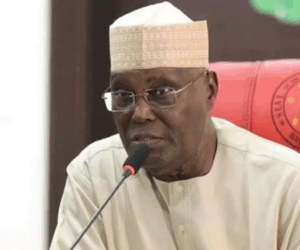
The Bishop of Sokoto Diocese, Matthew Hassan Kukah, has said that the growing belief that arming communities to defend themselves against terrorists and bandits will only offer a false sense of security.
Also, the National Security Adviser (NSA), Mallam Nuhu Ribadu, warned that any individual or group who attempts to exploit communities to spread terror or undermine national security will face decisive action.
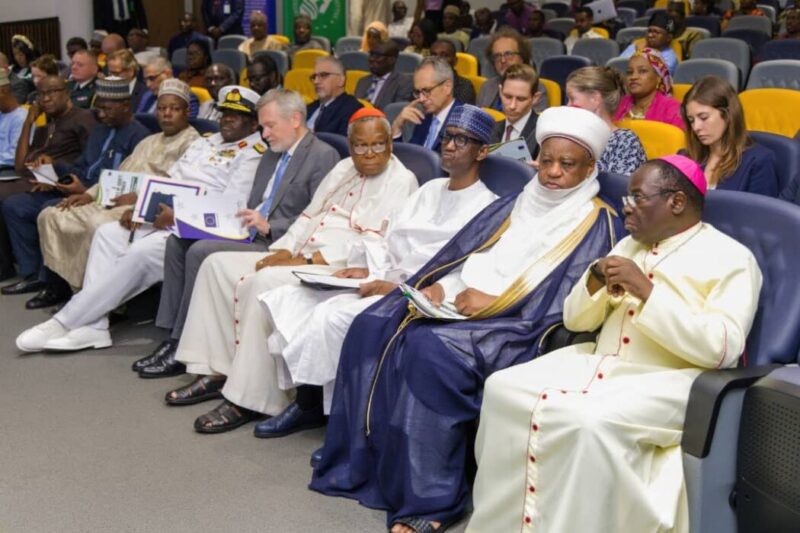
Speaking in Abuja on Thursday at a national dialogue on ‘A Whole-of-Society Approach to Prevention of Violence and Conflict in Northern Nigeria’, Bishop Kukah raised questions about what would happen to the weapons given to people to defend themselves if and when peace returned to the country.
The event was jointly organised by the National Peace Committee, the Kukah Centre, and the Office of the National Security Adviser (ONSA).
He said Nigeria has too many underlying ailments such as unstable homes, fragmented communities, weakened moral foundations, noting that these vulnerabilities created fertile ground for bandits and criminals to thrive.
Kukah emphasised that Nigeria can only overcome its security challenges when every citizen, irrespective of faith, ethnic or cultural background, comes together to fight the common enemy.
He said: “There is a growing belief that communities can defend themselves by arming up. But arms will not solve our problems. They offer a false sense of security.
“And when peace returns, where will those weapons go? As a Christian, it is not accidental that Jesus asked Peter to put back his sword. God’s teachings do not change; circumstances may change, but the truth does not.”
Kukah said that the scale and depth of the insecurity problem in the country showed that the people have hit rock bottom, and the only direction left was upwards.
He described the gathering as not a conversation for its own sake, but part of a long journey, which he said called on each of everyone in our various traditions to be custodians of conscience and custodians of hope.
“We meet because we believe Nigeria is worth fighting for—not with weapons, but with truth, courage, justice and compassion.
“Our gathering is meant to respond to the cries in our land—not to look for scapegoats or excuses. Nigeria remains a country searching for itself, blessed with extraordinary diversity.
“Our challenge is to turn that diversity into an asset, not a liability. Nation-building is about gathering and harmonising possibilities and skills from across the board,” Bishop Kukah stated.
Kukah said Nigeria should learn from the United States of America, which, he said, thrives today because of its diversity, adding that “If diversity were a liability, America would not be what it is.”
“Let us also acknowledge that peace cannot be outsourced. Peace is the collective work of all of us,” he said.
Kukah said that the whole-of-society approach dictates that every segment of the society must participate actively in solving the problem of insecurity.
According to him, the government must lead with humility, transparency and justice, while religious and traditional leaders must guide with courage, especially in confronting extremism within their own communities.
He said: “Civil society must mobilise voices and conscience. Their work is not just advocacy, it is a vocation.
“Women and young people must move from the margins to the centre. Too often, our African patriarchy assumes that wisdom belongs only to men. Yet women raise families and hold societies together.
“Peace begins with individuals, families, communities and societies. If each of us seeks peace where we are, the nation will benefit.
“We must build trust. We must speak for the voiceless. Women make up the majority of our population, yet many lack a voice—not because of numbers, but because voice means participation and representation. Too often, those elected to represent us end up representing only themselves.
“We must feel free to raise our voices. Citizenship is not only about voting; it is also about accountability. When leaders fail us, we must show the yellow card—and if necessary, the red card at the polls.”
In his remarks, the Sultan of Sokoto, Alhaji Sa’ad Abubakar III, described Nigeria’s diversity as asset, adding that embracing diversity strengthens Nigeria.
He noted that the country was facing kidnappings, killings, and attacks—all in the name of imposing beliefs.
He said that contrary to beliefs, Islam abhors extremism. “A true Muslim cannot be an extremist. Any text that is twisted to justify violence is a distortion of our faith.
“Education is critical to addressing extremism and false narratives. There is no inherent conflict between Islam and Christianity. Problems arise only between individuals, not between religions. If each person follows the teachings of their faith sincerely, peace is possible,” he added.
He, therefore, urged Nigerians to continuously dialogue, respect each other, and work towards a Nigeria that is peaceful, prosperous, and united.
“Only through truth, humility, and mutual understanding can we achieve lasting harmony,” Sultan stated.
Earlier, in his welcome remarks, the National Security Adviser (NSA) Mallam Nuhu Ribadu, warned that any individual or group who attempts to exploit communities, spread terror or undermine national security will face decisive action.
He said Nigeria has gone through difficult periods, perhaps more than many other nations but still standing .
He noted that Nigeria has recorded 775 convictions in terrorism related prosecution “each one representing not just a statistic, but a life restored and a community stabilised.”
According to the NSA, these achievements reflected what becomes possible when government institutions, the judiciary, security agencies, and communities work together in good faith.