4
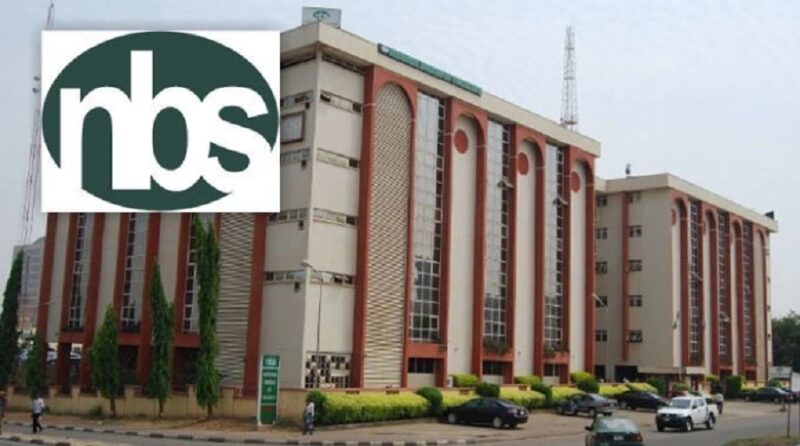
LAGOS – Nigeria’s economy posted stronger growth in the third quarter of 2025, expanding by 3.98 percent year-on-year and fueled by telecommunications, financial services, real estate, trade, and agriculture, according to the latest Gross Domestic Product (GDP) report released on Monday by the National Bureau of Statistics (NBS).
The figure marks a slight improvement from the 3.86 percent recorded in the same period of 2024 and reflects a broad-based but uneven recovery across major sectors.
The NBS report shows that real GDP rose to N57.03 trillion, up from N54.85 trillion in Q3 2024, while nominal GDP surged by 18.12 percent to N113.59 trillion, compared with N96.16 trillion a year earlier.
Analysts say the economy’s ability to sustain positive momentum amid inflationary pressures, tight monetary conditions, and a volatile global environment signals gradual resilience driven by reforms and sectoral diversification.
The services sector maintained its position as the largest contributor to national output, accounting for 53.02 percent of real GDP. Agriculture followed with a significant 31.21 percent, buoyed by stronger crop production, which remains the backbone of the sector and contributes nearly two-thirds of its nominal output.
The NBS attributed the overall growth to steady performance in key segments including telecommunications, financial services, real estate, trade, and crop farming.
These sectors provided crucial support at a time when the economy is navigating currency pressures, high input costs, and weak consumer purchasing power.
Agriculture recorded 3.79 percent real growth—an improvement that reflects the harvest season and government-supported initiatives targeting food production and security.
Significantly, the oil sector posted a real growth of 5.84 percent—slightly higher than 5.66 percent recorded in Q3 2024— supported by improved crude oil output. Average production rose to 1.64 million barrels per day, up from 1.47 million barrels per day a year earlier, though marginally below the 1.68 million barrels per day recorded in Q2 2025.
Despite a 5.53 percent contraction when compared with Q2, oil’s contribution to real GDP inched up to 3.44 percent, reflecting the sector’s ongoing recovery from years of disruptions, underinvestment, and crude theft. With Nigeria ramping up security efforts in the Niger Delta and attracting fresh investment into upstream assets, output is expected to strengthen further in subsequent quarters.
The non-oil economy, which accounts for the bulk of national output, expanded by 3.91 percent, outperforming Q3 2024 (3.79 percent) and Q2 2025 (3.64 percent). This segment continues to anchor GDP growth, driven largely by ICT, finance, agriculture, and trade.
ICT remained one of the fastest-growing sectors, posting 5.78 percent real growth and increasing its contribution to the economy to 9.10 percent. The performance reflects Nigeria’s deepening digital ecosystem, rising internet penetration, and sustained investment by telecom operators in network expansion and digital platforms.
Trade, which is highly sensitive to consumer income and inflation, grew by 1.98 percent, contributing 16.42 percent to GDP. Financial services, buoyed by sustained electronic payment adoption and stronger credit recovery, also supported overall output.
Real estate, a traditional indicator of economic health, recorded a striking 89.34 percent nominal increase and 3.50 percent real growth, signalling renewed activity in the property market despite high construction and financing costs.
Manufacturing, one of the sectors most affected by FX volatility and high energy costs, slowed to 1.25 percent real growth from 1.74 percent in Q2 2025. Its contribution to GDP dropped to 7.62 percent, highlighting continuing structural challenges including limited access to raw materials, costly import dependence, and high borrowing costs.
Construction grew by 5.57 percent, slightly below the 6.80 percent recorded in 2024, contributing 3.80 percent to GDP. Analysts say the sector’s performance reflects ongoing public infrastructure spending, though private sector activity remains constrained by high interest rates and project financing difficulties.
Education and health reported modest growth of 2.51 percent and 2.89 percent, respectively, underscoring persistent underinvestment and operational pressures in the social sector.
Statistician-General of the Federation, Prince Adeyemi Adeniran, noted that the Q3 estimates reflect enhanced data quality and broader sectoral coverage, aligned with Nigeria’s rebased national accounts framework.
He explained that while most sectors maintained positive momentum, growth remained uneven, with some industries still struggling under tight monetary conditions and elevated business costs.
Nonetheless, he emphasised that improved oil output, stronger non-oil activity, and rising business confidence supported overall recovery.
Nigeria’s Q3 performance comes on the heels of an upward revision of the country’s 2025 growth forecast by the International Monetary Fund (IMF). In October, the IMF projected a 3.9 percent economic expansion in 2025—citing higher oil production, improved investor sentiment, and a more supportive fiscal stance.
The Fund also raised its 2026 growth expectation to 4.2 percent, while revising 2024 growth upward to 4.1 percent.
Economists say Nigeria’s improved data aligns with these projections, though sustained progress will depend on stabilising the naira, easing inflation, boosting energy supply, and accelerating critical reforms in infrastructure, agriculture, and manufacturing.
With Q4 typically stronger due to festive-season demand, analysts expect full-year 2025 growth to track close to the IMF’s projections—setting the stage for a potentially stronger economic outlook in 2026.