
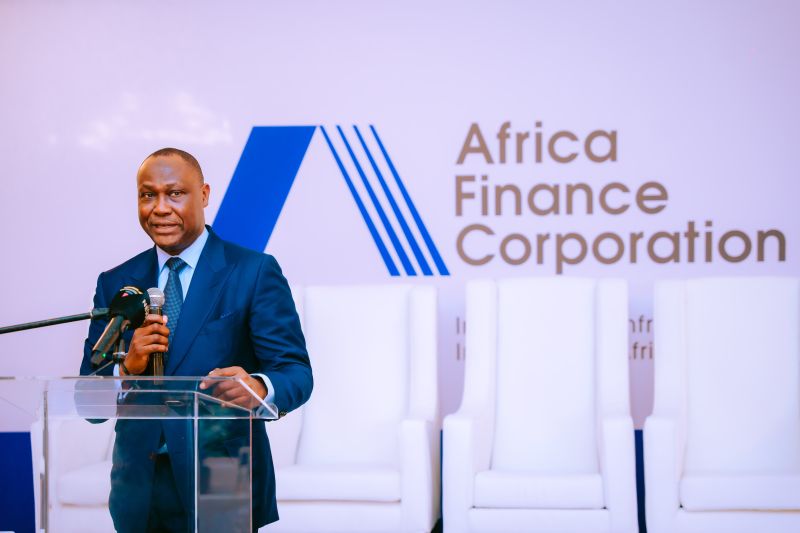
Africa Finance Corporation (AFC), the continent’s leading infrastructure solutions provider, has raised $524 million equivalent dual-currency Samurai term loan facility to boost its mandate of driving sustainable development through critical infrastructure investment across Africa.
This was disclosed in a statement by the company seen by Technext. Per the statement, the transaction marks the AFC’s largest Samurai loan to date and reinforces the corporation’s growing footprint in Japan’s capital markets amid rising investor confidence in its credit fundamentals.
The three-year syndicated facility, comprising $505 million and JPY 3 billion, was oversubscribed following strong demand from Japanese lenders.
“Japan continues to be an important and strategic market for AFC. The strong support from Japanese lenders in our latest Samurai loan underscores the depth of confidence in AFC and the trust we have built with investors over the past few years.
This successful transaction strengthens our funding base and expands our global investor reach as we continue mobilising capital to address the infrastructure deficit in Africa,” Banji Fehintola, Executive Board Member and Head of Financial Services at AFC, said.
According to the corporation, its strong traction in Japan has been supported by a series of milestones. This includes its 2019 debut samurai loan, its 2023 guarantee of the Arab Republic of Egypt’s JPY75 billion Samurai Bond and the award of an A+ (Stable) long-term issuer credit rating by the Japan Credit Rating Agency (JCR) earlier this year.
However, its 2022 Samurai facility of $419 million equivalent – $412 million and JPY 1 billion – matured in October 2025 and was fully repaid by AFC.
Read also: Only 0.03% of global AI funding came to Africa in Q3 despite global funding boom

Africa Finance Corporation’s investments in African countries
Since its founding in 2007, the Africa Finance Corporation (AFC) has significantly expanded its influence and investment footprint across Africa by strategically deploying capital in high-impact infrastructure projects.
Its strategy involves penetrating new markets by financing catalytic, revenue-generating projects that support regional integration and industrialisation. It has steadily expanded its sovereign membership to 47 African countries, representing an increasingly broad geographical spread across the continent.
This continuous accession of new member nations, such as Benin, Botswana, the Democratic Republic of Congo (DRC), and Somalia in recent years, provides the Corporation with diplomatic privileges and facilitates greater on-the-ground engagement in these key economies.
In Ghana, around 2014-2015, the AFC acted as a lead developer and investor in the $900 million Kpone Independent Power Project (Kpone IPP), establishing a major 350MW gas turbine and substation to boost the country’s power infrastructure.
In Côte d’Ivoire, the AFC has invested in both transport and power since the early 2010s, notably through financing the Henri Konan Bedie Bridge in Abidjan and later supporting the construction of the 44MW Singrobo Hydro Power Plant.
In its home base of Nigeria, the AFC deployed a significant $170 million loan (c. 2013) toward the acquisition and operation of the 1,338 MW Kainji Hydroelectric power plant, alongside other foundational investments in the oil & gas and telecoms sectors. It also committed over N500 million to the Central Bank of Nigeria’s private sector coalition against COVID-19.
Its reach extends to smaller economies like Benin and Togo, where it is a principal financier for the development of Special Economic Zones and ports through its collaboration with ARISE IIP, aiming to boost industrial exports.
Moving eastward, the AFC has focused on sustainable power projects. In Djibouti, in the 2020s, AFC became the lead developer for the 60MW Djibouti Wind Project, aiming to support the nation’s goal of achieving 100% renewable energy generation.
In Rwanda, the corporation invested in the 80MW Hakan-Quantum Peat Power Plant, diversifying the national energy mix. To enhance regional connectivity, the Corporation has provided financing for the Ethiopian Airlines expansion in Ethiopia and has invested in upgrading the power transmission and distribution network in Kenya via KPLC infrastructure expansion.
The expansion into Southern Africa has seen investments across the natural resources and transport sectors. In Botswana, AFC provided a $44 million senior debt investment in Lucara Botswana Ltd for the expansion of the Karowe Diamond Mine, a key resource project. In South Africa, the Corporation invested in critical transport infrastructure, such as the Bakwena Toll Road, enhancing logistical efficiency.
AFC also plays a role in the strategic resource sector of the Democratic Republic of Congo (DRC), having provided a $40 million investment for the construction of the Etoile Copper and Cobalt mine.
The Corporation’s cumulative investment and disbursement volumes have grown significantly. AFC has invested over $17 billion in infrastructure projects across 36 African countries since its inception.
Read also: South African Reserve Bank buys 50% of PayInc, igniting a new era for digital payments