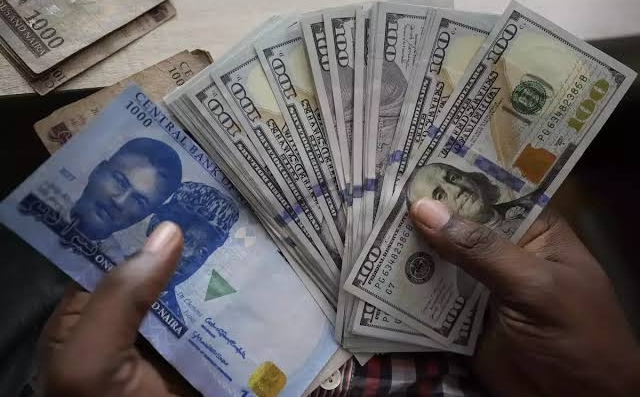
The Nigerian Naira has demonstrated resilience against the US Dollar in early trading on Thursday, December 4, 2025, maintaining a narrow gap between official and parallel market rates as Nigeria enters the final month of the year.
Official Market Performance
Data from the Nigerian Foreign Exchange Market (NFEM) shows that the Naira is trading at approximately ₦1,445.54 per Dollar this morning.
Market activity indicates stability, with the currency fluctuating between an intraday high of ₦1,448.20 and a low of ₦1,444.90.
The sustained performance reflects the Central Bank of Nigeria’s (CBN) ongoing efforts to unify rates and enhance liquidity through the Electronic Foreign Exchange Management System (EFEMS).
Parallel Market Trends
In the unauthorised parallel market, the Naira is exchanging at an average of ₦1,468 per Dollar.
Dealers report moderate demand, with rates holding steady near the ₦1,470 mark observed earlier this week. The compressed gap between official and street rates marks a significant improvement compared to previous years.
Economic Context
The relative stability of the Naira coincides with improving macroeconomic indicators. One year after the full implementation of EFEMS, the currency has recovered from the historic lows seen in 2024.
Inflation Eases
The National Bureau of Statistics (NBS) reported that headline inflation declined to 16.05% in October 2025, marking the seventh consecutive month of reduction. Analysts attribute this easing to renewed confidence in the local currency.
Monetary Policy Outlook
The CBN’s Monetary Policy Committee (MPC) on November 25 voted to retain the Monetary Policy Rate (MPR) at 27%.
The decision, following a slight reduction in September, underscores the apex bank’s commitment to keeping inflation under control while supporting the stabilised exchange rate.
Future Outlook and Regulatory Changes
Market sentiment remains cautiously optimistic, aided by stabilised foreign portfolio inflows that have boosted Nigeria’s external reserves to approximately $44.66 billion.
Investors and citizens are also preparing for the CBN’s newly announced cash management guidelines, effective January 1, 2026.
Stricter cash withdrawal limits aim to curb money laundering, reduce cash handling costs, and encourage wider adoption of electronic payment channels, supporting the Naira’s long-term value.