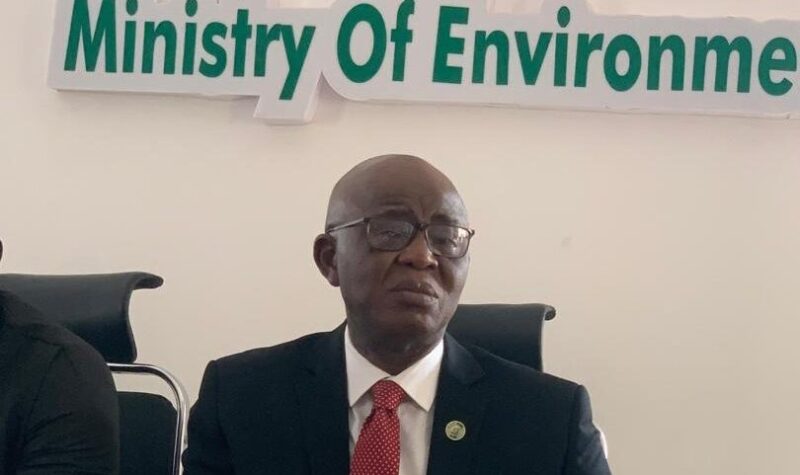
The Commissioner for Environment, Ola Oresanya, has commended PREMIUM TIMES and its reporting partners for their investigative reporting on industrial pollution in the Ogijo axis, saying the exposé helped accelerate government action on what he described as a matter of public health emergency and global interest.
Mr Oresanya spoke during a high-level technical session with researchers, environmental regulators and representatives of lead recycling companies at the Ogun State Secretariat, Abeokuta, on Monday.


The commissioner said the ministry welcomed the role of PREMIUM TIMES, Nigeria’s leading investigative news outlet, in bringing long-standing community complaints to national attention.
“We have to thank you for this,” he told the PREMIUM TIMES’ reporting team present at the stakeholders’ meeting.
“You have done your job, and we want to bring you along so we can enrich your further publications with all our activities.”
The commissioner noted that, as the fourth estate of the realm, the media has a responsibility to serve as a societal watchdog, set the agenda for society, and spotlight key issues for government and policymakers to address.


The meeting, which lasted several hours, outlined a detailed plan for soil, water, dust, air quality, and vegetation sampling around several lead-acid battery recycling plants that had recently been shut down by the state.
The scientific team, comprising environmental experts from three tertiary institutions, Olabisi Onabanjo University (OOU), the Federal University of Agriculture, Abeokuta (FUNAAB), and the University of Lagos (UNILAG), volunteered to join the environmental impact audit team and outlined a comprehensive sampling plan.
Babatunde Bada, a professor of Environmental Management and Bioremediation at FUNAAB, explained that the multidisciplinary team would take samples of soil, dust, water, and vegetation across multiple distances from the factories to determine the extent of the lead dust spread.
“The pollution can travel far. We are not going to limit the sampling to the spot,” he said. “We will collect dust, soil, different water sources and vegetation to know the extent of pollution.”
Another environmental expert from FUNAAB, T.M Taiwo, noted that mapping the directional flow of pollutants, especially through wind patterns, was crucial.
“Where the pollution is going is the major issue,” he said, noting that contaminants could travel inland into Lagos State.
He also urged the acquisition of specialised samplers capable of measuring particulate matter and heavy metals, including dangerous associated metals such as antimony. He recommended using ICP-OES technology to test for up to 70 elements in the samples.
On her part, Ayodele Oso, the head of Air Quality and Emission Control from the Lagos State Environmental Protection Agency(LASEPA) said Lagos State has six ARA air samplers capable of Particulate matter 10 and Particulate matter 2.5 measurements, as well as stationary low cost monitors that can detect gases such Carbon dioxide, CO2, Ozone, Sulphur Dioxide, SO2₂ in real time.
The stakeholders meeting appointed Toyin Arowolo, a professor of Analytical and Environmental Chemistry, as coordinator of the combined research effort. The research team’s mandate encompasses testing of air, water, soil, and vegetation.
Audit
The commissioner said consultants who routinely file environmental compliance reports for the recycling plants would have their submissions reviewed publicly.
“When an industry is not doing well, and we shut it down, the integrity of the consultant is at stake. We will interrogate your reports and make them public,” he said.
When asked about the fate of the companies should the government find them culpable, the commissioner stated that the recycling companies would be shut down permanently.
“If we find out that this process is killing people, they are not staying there. There is no amount of tax or job that is worth people’s lives,” he said.
He said the industries may face two options, either to relocate to a new site with modern equipment or shut down permanently
He further emphasised that results would affect all operators equally. “For now, everyone, whether okay or not, faces a blanket ban. This process will tell us the truth.”
What our investigation found
Last week, the Federal Government shut down True Metals Nigeria Limited and other lead battery recycling companies in Ogijo, a community in Ogun State, following an investigation by PREMIUM TIMES and The Examination, a nonprofit newsroom that investigates global health threats.
The investigation, revealed that the lead recycling factories in Ogijo have poisoned the very air residents breathe and the soil where children play. The report also documented unsafe working conditions in the lead recycling facilities.
Scientists collected 70 blood samples from factory workers and residents, finding that every worker tested showed dangerous lead exposure, with some levels as high as 38 µg/dL, which is many times above the World Health Organisation’s recommended limit.
Children in the community were not spared; eight out of 14 tested children had blood-lead levels exceeding five µg/dL, a threshold that health experts say poses serious risks to cognitive development.
Soil and dust samples collected around homes, farms, and a nearby school also showed catastrophic levels of contamination. In one school playground, the soil contained more than 1,900 ppm of lead, almost five times the level of many international safety limits.
Residents and workers reported chronic illnesses and symptoms consistent with lead poisoning, such as recurring stomach pains, fatigue, and poor concentration. Some families described their lives as being slowly suffocated by the black soot from the factory chimneys, fearing that their children’s futures had been stolen by a toxic smoke emitted by these factories.
Inside the plants, workers described a routine of crude, unsafe practices where used batteries are smashed by hand or with axes, molten lead is handled without adequate protective gear, and waste slag and lead dust are left exposed, allowing toxic particles to wash into soil or drift into the air.
READ ALSO: Ogijo Pollution: Lead recycling companies to remain sealed until conclusion of audit report
Timeline of impact
Since the release of the two-part investigation, federal and state ministries, departments, and agencies of government responsible for upholding labour and environmental laws have begun taking action, following about a decade of poor regulatory oversight.
On Monday, 24 November, the Minister of State for Labour and Employment, Nkeiruka Onyejeocha, led her team to seal up True Metals Nigeria Limited and Phoenix Steel Mills Limited.
During an inspection of True Metals, the battery-recycling plant at the centre of the investigation, the minister said she found workers operating in what she described as “hazardous and dehumanising conditions.”
Days later, on Thursday, 27 November, the Commissioner for Environment, Ola Oresanya, led a combined team of experts from the Ministries of Environment and Health, OGEPA, and NESREA, to Ogijo and ordered the closure of seven lead recycling factories.
Earlier in September, NESREA announced the seal up of 9 lead recycling factories, after it received a copy of the soil and blood test results commissioned by The Examination and prepared by STRADev, a non-governmental environmental health organisation.
In addition, Chris Pruitt, executive chairman of the board of East Penn Manufacturing, a major US battery manufacturer with ties to Nigerian companies, told The Examination and its partner newsrooms that East Penn had stopped buying lead from Nigeria and begun to tighten its supplier code of conduct.