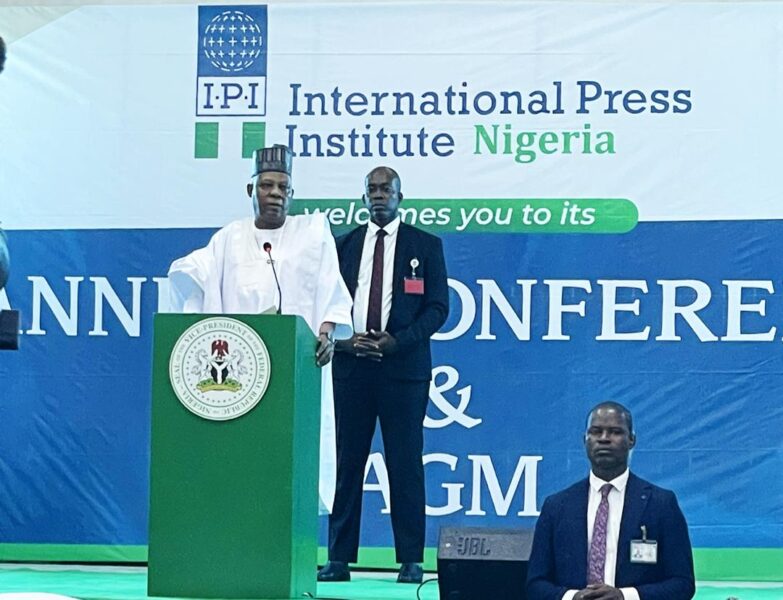
Vice-President Kashim Shettima, on Tuesday, said the country’s journalists remain the most reliable barrier against authoritarian rule, insisting that no administration, past or future—can successfully suppress the Nigerian media.
He stated this while delivering his address titled, “The Nation That Defies Silence”, at the 2025 Annual Conference and General Meeting of the International Press Institute (IPI) Nigeria, held at Nicon Luxury Hotel, Abuja. The conference has the theme, “Addressing Media Repression and Safeguarding Democratic Accountability in Nigeria.”


The vice president noted that the Nigerian media’s long history of courage and independence has ensured the survival of democratic accountability, especially in moments of political tension.
“Never in our history has any person or government succeeded in suppressing the media permanently. You have stood firm in the coldest nights of national adversity, and you have outlived those who attempted to place their boots upon your freedom,” he said.
‘Architects of national consciousness’
Mr Shettima opened his remarks by describing the press as the architects of national consciousness, saying journalists possess the power to “build dreams or dismantle illusions,” and to either strengthen public hope or plunge a country into fear.
“Our aspiration is to witness the finest expressions of this craft—where truth, not convenience, becomes the supreme editorial policy,” he said. “So I am honoured to share the company of these professional troublemakers today,” he added.


He praised generations of Nigerian journalists for repeatedly rising in defence of the public’s right to know, even in periods marked by political confusion and deliberate misinformation.
Journalists commended for resisting disinformation
One of the strongest parts of his speech focused on what he called “Foreign Information Manipulation and Interference.”
He commended the “overwhelming majority” of Nigerian journalists for confronting disinformation campaigns and refusing to be “foreign puppeteers’ instruments.”
“You have stood firmly against disinformation and refused to surrender your pens to falsehoods,” he said.
Mr Shettima also noted that the media’s most sacred duty is protecting democracy—sometimes from politicians, and at other times from politicians themselves.
“Democracy is safe only when power is under constant observation and it is safe only when those who observe do so with integrity rather than vendetta,” he said.
He acknowledged the tension that often characterises relations between journalists and political leaders, describing it as “the friendship of a cat and a mouse,” but stressed that both sides are “better off as friends.”
He also highlighted the role of IPI Nigeria as a standard-setter for ethical journalism, urging practitioners to uphold verification, accountability and professionalism.
According to him, the government–media relationship must be rooted in openness, mutual respect and shared commitment to the public interest.
He however warned that a “minority” within the profession – those who deliberately publish unverified or fabricated claims – undermine the credibility of the media and distort national discourse.
He also cautioned that countries that weaken or silence the press inevitably lose both governance direction and public voice.

“A nation where the media is silent is a nation where public officers lose their way, and where the people lose their voice,” he said.
He assured journalists that the administration sees them not as adversaries but as partners essential to the survival of Nigeria’s democracy.
“I stand before you today not as a wary politician, but as a friend who acknowledges your indispensable role and assures you that this administration will continue to protect your right to freedom of expression.”
The vice president reiterated that the Tinubu administration remains committed to safeguarding press freedom and ensuring journalists can work without intimidation.
“We owe you a space of practice devoid of harassment, intimidation, or fear. That much is non-negotiable. As a government, we must continue to create an environment where truth can thrive without obstruction,” he noted.