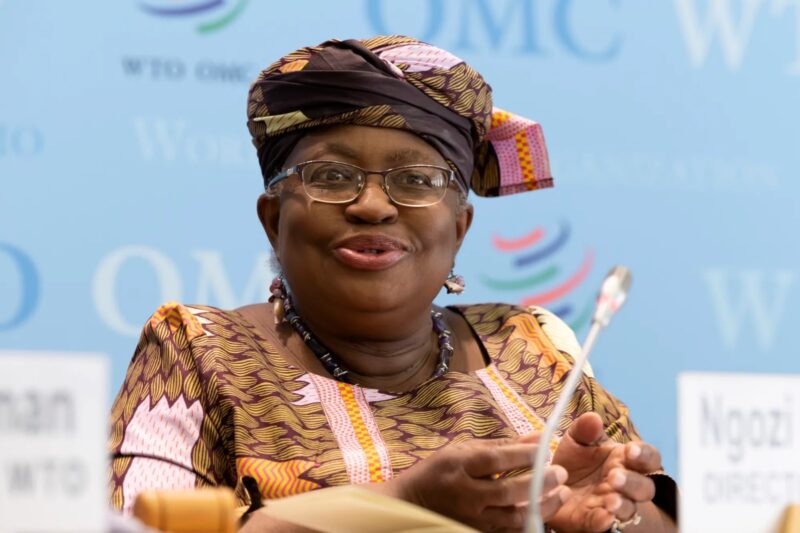
The Nigerian-American economist, Dr Ngozi Okonjo-Iweala, recently said, “It costs 20 per cent more for us to trade with each other on the continent than with the rest of the world. Something is wrong with that.”
These are not idle words. They serve as a wake-up call from Ngozi Okonjo-Iweala, who made history as the first woman and first African to lead the World Trade Organisation (WTO). Standing at the helm of global trade, Okonjo-Iweala is on a mission: to transform Africa from a continent of trade barriers into a hub of opportunity.
The African Continental Free Trade Area (AfCFTA) promised a new era of commerce—integrating markets, reducing tariffs, and boosting industrial growth. Yet, nearly three years after its launch, intra-African trade remains stubbornly expensive and inefficient. “We need to bring our average costs down,” Okonjo-Iweala told CNN’s Christiane Amanpour, cutting straight to the heart of the continent’s economic puzzle.
Trade costs are more than numbers—they are barriers to opportunity. High costs prevent small businesses from scaling up, deter women entrepreneurs, and hinder industrial expansion. Okonjo-Iweala warns that without reforms, Africa risks leaving its own potential untapped while its trading partners overseas profit from cheaper and more efficient markets.
Her solution: a combination of policy reform and global cooperation. At a recent high-level dialogue co-hosted by Chile and the Republic of Korea, she championed the Investment Facilitation for Development (IFD) Agreement—a framework designed to simplify investment rules, promote transparency, and cut bureaucratic red tape.
“By lowering costs associated with investment flows, the IFD Agreement can help developing countries attract and retain more sustainable investment,” she said. “This is about new technologies, diversified economies, and better jobs for people.”
The stakes could not be higher. Research by the German Institute of Development and Sustainability suggests that the IFD Agreement could generate global welfare gains between USD 295 billion and USD 1,041 billion, with the majority of benefits accruing to low- and middle-income countries. Small and women-led businesses, she stressed, stand to gain disproportionately, positioning them as engines of growth in an evolving Africa.
Okonjo-Iweala’s voice carries weight because she has walked the corridors of global finance and national policy alike. Born in Ogwashi-Uku, Delta State, Nigeria, in 1954, she graduated from Harvard and earned a PhD in regional economics and development from MIT. She spent 25 years at the World Bank, culminating in her appointment as Managing Director of Operations, before returning to Nigeria to serve twice as the first female Minister of Finance—achieving a historic $30 billion debt write-off.
In March 2021, she broke the ultimate glass ceiling, taking the reins of the WTO. Since then, she has been a relentless advocate for reform, inclusivity, and sustainable investment. Beyond trade, she has served on boards ranging from Gavi to Twitter and has been appointed as the Special Envoy for COVID-19 to the African Union and the WHO.
“Africa’s future cannot wait,” she says. And with her at the helm of global trade, that future looks more attainable—and more urgent—than ever.