New research shows that Nigerian women in politics now face a growing wave of technology-facilitated gender-based violence (TF-GBV), adding a dangerous layer to their long-standing struggles with marginalisation and underrepresentation.
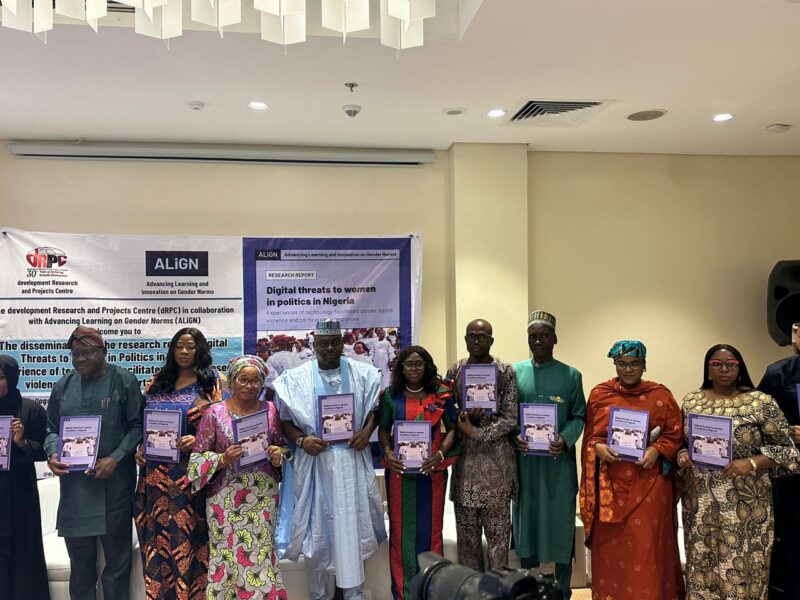
The study, “Digital Threats to Women in Politics in Nigeria: Experiences of Technology-Facilitated Gender-Based Violence (TF-GBV) and Political Parties’ Responses,” documents how digital spaces—from social media platforms to private messaging groups—are increasingly weaponised to intimidate and silence women seeking political office.


The research was conducted by the development Research and Projects Centre (dRPC) under the Advancing Learning and Innovation on Gender Norms (ALIGN) platform, with funding from the Overseas Development Institute (ODI). It was presented to the public on Friday.
According to the report, TF-GBV has emerged as an entrenched feature of Nigeria’s political environment, mirroring global trends of rising online misogyny, anti-gender backlash and weak regulatory responses from technology companies.
Digital violence as a political weapon
Drawing on engagements with female politicians and political party leaders across Imo, Kogi, Ondo and Rivers states, the research finds that digital abuse is now one of the most formidable barriers preventing women from entering or remaining in politics.
The report assesses how political parties perceive TF-GBV, how their internal structures and ideologies shape their responses, and how broader political and social norms fuel both the violence and the silence surrounding it.


The findings show that political parties, key democratic actors with a responsibility to safeguard participation, are largely failing to address the threat.
“Women’s underrepresentation in politics is one of the most persistent democratic deficits globally,” the report noted. “Yet most political parties in Nigeria do not sufficiently address TF-GBV, let alone strive to prevent it.”
The research describes TF-GBV as an urgent and escalating concern that often drives women away from political life. Women who are marginalised based on age, ethnicity, or marital status face an even higher burden of digital attacks.
Patterns of abuse
The study shows that technology-facilitated violence is not random but follows clear, predictable patterns tied to Nigeria’s political cycle. TF-GBV spikes during campaigns, elections, or when women gain prominence through appointments or policy debates.
Perpetrators frequently weaponise patriarchal norms to delegitimise women’s participation. Attacks often question a woman’s competence, mock her appearance, or smear her morality and sexuality.
The report documents instances where women politicians were targeted with sexist slurs, rape threats, doxxing, cyberstalking, and coordinated smear campaigns. These abuses are typically amplified by pseudonymous accounts or party loyalists.
“A resistance to women’s political empowerment has intensified with online attacks becoming the new frontline of domestic politics,” the study states. Nigeria’s low female parliamentary representation—just 4.5 per cent—exists alongside a rising digital environment hostile to women.
Key findings
Technology-facilitated gender-based violence (TF-GBV) is the new frontline of political violence against women in Nigeria, the study said.
The report found that perpetrators of TF-GBV weaponise patriarchal gender norms to keep women out of politics. “They use sexist slurs on social media, doxxing or threats of rape and murder in messenger groups to intimidate and delegitimise women political candidates.”
“Abuse follows a misogynistic script rooted in gender stereotypes and norms – with attacks focused on questioning competency, belittling appearance, or challenging morality and sexuality.”
It also noted that online abuse is not random but fits a clear pattern. “There is a clear ‘visibility penalty’ for women politicians, with attacks spiking during campaigns, elections or when they gain prominence through a high-profile position or policy debate.”
Researchers noted that political parties are not blind to TF-GBV – they’re often complicit. Often, TF-GBV is perpetuated by politicians and their supporters as part of electoral politicking – both within their own parties and against competitors. Accountability is rare, and institutional support systems are weak or non-existent, the researchers said.
“Gendered abuse does not impact all women equally – it’s intersectional. Age, ethnicity, marital status, and political experience shape how women are targeted. Young women face sextortion and gatekeeping; mid-career women are stalked and smeared; and cultural stereotypes fuel both online and offline discrimination.”
Methodology
The report draws on the analysis of social media posts on platform X, key informant interviews with women politicians from four states, Imo, Kogi, Ondo and Rivers, who come from across the country’s political landscape, and a review of party documents. It is part of a joint ALIGN research project in partnership with the development Research and Projects Centre (dPRC) and Data Pop Alliance (DPA) in Brazil.
Additionally, 28 semi-structured interviews were conducted with women politicians and officials from various political parties.
The study’s X analysis, covering over 140,000 posts from 2022 to 2025, targeting female candidates in the four states, reveals the scale and patterns of TF-GBV.
“Gender stereotypes (e.g., ‘ashawo’, ‘slut’) dominated mentions, followed by attacks on the appearance and/or personality of women politicians and the questioning of their competence.
“Peaks aligned with campaigns (October 2022–January 2023), elections (February–March 2023), and election petition tribunals (April–September 2023), with 2023 recording the highest count of abusive posts across a three-year time series. Peaks were also associated with the visibility of female candidates,” the report said.
It also found that pre-campaign abuse was competency-focused, shifting to stereotypes during elections and moral attacks post-election. “During primaries, perpetrators included intra-party rivals. This shifted to inter-party rivals post primaries. These attacks were amplified by retweets and pseudonymous accounts,” the study said.
“Official party responses were minimal, with searches of political parties’ X handles showing no TF-GBV-specific statements. Moderation gaps on the X platform were evident in the scraped posts: around 30 per cent of abusive content was deleted, 25 per cent was removed by X, and 40 per cent was inaccessible because it appeared within private groups.”
Findings from the key informant interviews shed light on the mechanisms and consequences of TF-GBV.
“Abuse was cyclical with defamation and smears peaking post-election, sexualised slurs increasing across phases, and threats escalating the risks. Women politicians interviewed noted that abuse, often in the form of smear campaigns, was initiated primarily on platforms like Facebook, while coordinated attacks occurred within WhatsApp groups.
“Although these abuses may have originated on both platforms, X is the platform that tends to be used to amplify and spread the abuse more widely. Perpetrators are often men from the same party, who view women as threats. Demographic identities intersect, with younger women (25–44 years) facing entry barriers like sextortion; mid-career groups endure stalking; and factors like ethnicity and marital status compounding stigma (e.g., ‘not married, so unfit’).”
Consequences of TF-GBV
The consequences of TF-GBV extend far beyond the digital world. Women reported reputational damage, emotional distress, family pressure and financial costs linked to security and legal action, the report said.
Some cases triggered household strains, withdrawals from contests, or decisions to leave politics entirely.
Women rely primarily on peer networks, family support, personal resilience, or informal mentoring to cope. Formal mechanisms for reporting or redress are largely absent.
Political Parties: Complicit and unresponsive
One of the most striking revelations from the report is that Nigerian political parties do not treat TF-GBV as gendered harm. Instead, parties often frame it as “rough politics”, an inevitable part of the competitive landscape, the report said.
This perception, the report argues, normalises violence and masks the disproportionate impact it has on women. By treating digital abuse as non-gendered and unavoidable, parties risk further entrenching low female representation.
“Political parties’ responses are typically informal, involving internal resolutions, rare sanctions, or external deferral, and their policies on discrimination often suffer from ‘weak implementation’. Women seeking redress often face challenges, including weak enforcement and fear of backlash, which perpetuate impunity. A gender review of the constitutions of Nigeria’s 19 political parties shows that none address TF-GBV explicitly, despite commitments to women’s participation.
Conclusion
The study concludes that TF-GBV has become a systemic tool that reinforces patriarchal norms in Nigeria, with gaps in laws, party constitutions and governance structures enabling the silencing of women and keeping female political representation low.
While the trend mirrors global patterns, it is intensified by Nigeria’s digital environment and patronage-driven politics.
The report recommends preventive reforms, urging political parties to embed TF-GBV clauses in their constitutions, codes of conduct and ethics documents to shift norms and create safer spaces for women. It calls for formal mechanisms to report, investigate and sanction perpetrators, alongside training on gender sensitivity and digital safety. Parties are encouraged to strengthen women’s leadership roles, enforce anti-discrimination policies and work with electoral bodies to ensure accountability.
Addressing intersectional inequalities and providing resources for evidence gathering and legal support will help reduce impunity and enable women to remain in politics, the report adds.
For long-term change, the study urges amendments to existing legal frameworks to fully recognise and address TF-GBV and for stronger safeguards on social media platforms. It recommends that INEC integrate the study’s findings into its ongoing review of the Gender Policy, which expires in 2025, noting the current lack of political will within political parties. It also calls for the adoption of the 2022 ACHPR Resolution on protecting women from digital violence and for INEC and IPAC to mandate TF-GBV monitoring, reporting and inclusion in party codes of conduct.
READ ALSO: dRPC launches report on digital threats to women in Nigerian politics (LIVE UPDATES)
About dRPC
The dRPC is a prominent non-profit organisation formed in Nigeria in 1993 to advance development knowledge and action through civil society collaborations in which gender is cross-cutting.
It is at the forefront of conducting primary research on development issues and problems that impact the lives of women and girls using participatory and qualitative research methodologies.
Its research findings generate evidence for advocacy engagements and offer recommendations for policy and administrative reforms in Nigeria.
With a strong commitment to gender equality, good governance, and development, dRPC has played a pivotal role in shaping the discourse on development issues in Nigeria and has consistently worked to enhance the well-being and opportunities of marginalised communities.
Over its 30 years of existence, the dRPC has designed and managed development projects where it has trained, mentored and provided seed funds to hundreds of civil society organisations, most of which are women-led, and many government ministries, departments and agencies at the national and subnational levels, supporting both constituencies for effective participation in policy analysis and change.