
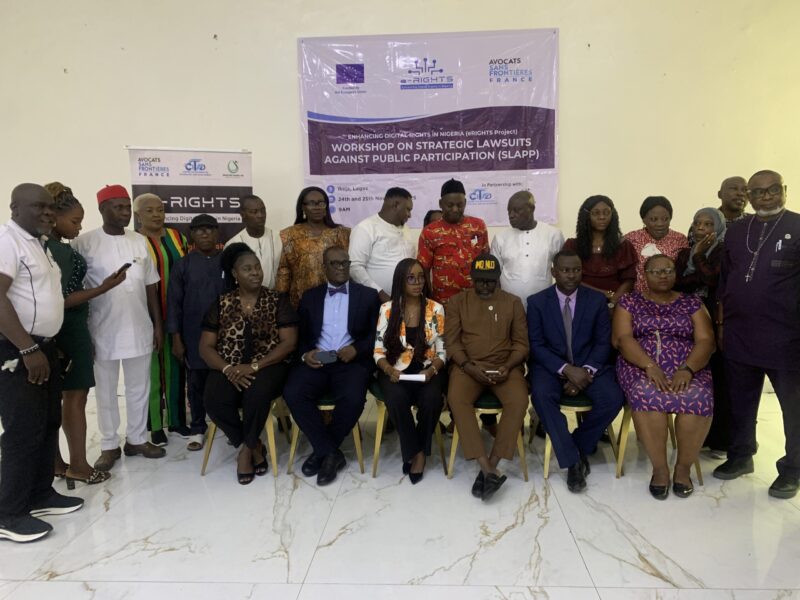
The Avocats Sans Frontières France (ASF), also known as the Lawyers Without Borders, has called for the urgent implementation of an anti-SLAPP (Strategic Lawsuit Against Public Participation) in Nigeria to protect journalists, activists, and public interest advocates from baseless lawsuits.
The human rights organisation made the call during a two-day SLAPP training workshop with journalists in Ikeja, Lagos, between 24 and 25 November.


SLAPPs are legal actions designed to suppress freedom of expression, primarily targeting journalists by imposing substantial burdens, such as the expense of legal defence, the threat of criminal prosecution, prolonged litigation, and damage to reputation, thereby generating social pressure with the hope that they will abandon their criticism or reportage.
ASF France is an international human rights non-governmental organisation dedicated to promoting and protecting fundamental rights and establishing the rule of law.

Anti-SLAPP
Abiodun Odusote, an associate professor of law at the University of Lagos (UNILAG) and one of the facilitators, argued that an anti-SLAPP legislation is essential to protect the fundamental democratic principles of free speech and public debate.
Mr Odusote said that it would be a herculean task to get it passed; however, its success would lead to good governance and transparency.


He said that “clearly once a case falls under these parameters (SLAPP), it will be dismissed.”
According to the lecturer, SLAPP is the weaponisation of the law against free speech to retain the status quo, even when the lawsuit filed has no merit.
The call for an anti-SLAPP law comes amidst growing concern that powerful entities, corporations, and wealthy individuals are increasingly using the threat or execution of costly and drawn-out legal proceedings to silence critics, journalists, consumer advocates, and public interest groups.
The benefits of anti-SLAPP legislation include pro bono services, a lower burden of proof to demonstrate merit in the case, and speedy trials, among others.

Documentation
Earlier, on Monday, ASF France Country Director Angela Uzoma-Iwuchukwu, in her welcome speech, explained that SLAPP laws are often targeted against journalists.
Mrs Uzoma-Iwuchukwu said the lawsuits often exploit the legal system to silence journalists, adding that SLAPP can include civil lawsuits, anti-corruption charges, and tax compliance issues.
She urged journalists to “document patterns and incidents of SLAPPs (dates, actors, legal pathways used) to build case records and inform strategic litigation and advocacy.”
She highlighted the importance of recognising patterns in SLAPP cases to properly document and address them.
Mrs Uzoma-Iwuchukwu explained that the training is part of the E-Rights Project, funded by the European Union, aimed at enhancing digital rights in Nigeria.
She also noted the organisation’s efforts to support journalists, including training and representation at both the national and regional levels.

Media as a cornerstone of democracy
Meanwhile, Folashade Adegbite, lecturer at UNILAG, emphasised the importance of media freedom as a cornerstone of democracy, comparing it to the pillars of a building.
Mrs Adegbite spoke on the resilience of democratic foundations, even when faced with external threats and how journalists can avoid such lawsuits.
She explained the limitations on freedom of expression, the Cyber Crime Act and its impact on media freedom, including internet shutdowns and the withdrawal of licenses.