
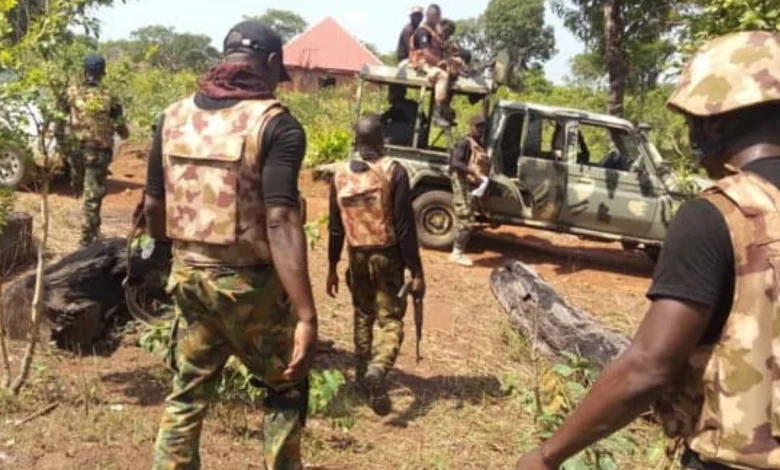
In recent days, Nigeria has once again been reminded of a hard truth: mourning losses and offering condolences will not suffice to win the war against terror. Our national enemy remains real and resilient. The question today is no longer only, Who brought them and from where? Although those enquiries remain valid, they are not sufficient to protect our country from further destruction.
Across the northeast and beyond, the battle lines are clear. Militants from Boko Haram and its offshoot, Islamic State West Africa Province (ISWAP), continue to launch bold attacks. Just within this November, coordinated assaults on two military bases in Borno State led to the deaths of soldiers and the overrunning of a forward operation base; on November 17, a vice principal was killed and 25 students were abducted in a boarding school in Kebbi; on November 19, three were killed and about 40 abducted at a church service in Kwara; and on November 21, over 50 students were abducted in the early hours of Friday in Niger State.
Read also: Closing schools amounts to surrendering to terrorists PDP
In August 2025, precision airstrikes by the Nigerian military reportedly killed at least 35 militants near the Cameroon border in a confrontation with these insurgents.
These are not isolated skirmishes. They represent a conflict that has been festering for more than a decade, ever since Boko Haram first took up arms in 2009, and even longer if one looks at the root causes.
After more than 15 years, we must ask ourselves, has lamentation been enough? Has weeping and wringing of hands changed the trajectory? Sincerely, no.
This is the stage we are at now: not just a war to be fought on battlefields, but a war of strategy, of will, of operational transformation. The enemy is adapting tactics, recruiting, and infiltrating; we cannot afford to remain in yesterday’s mindset. The time for decisive action is now.
“Strategy must integrate these border realities, intelligence sharing, regional cooperation and domestic resilience.”
That means every actor has a role, but none more so than those in current authority, those who hold the levers of strategy, resources, law enforcement, and defence. They are the ones entrusted by our democratic system to protect the citizenry, defend lives and property, and uphold the Constitution. Our democracy is fragile. If the state hesitates in this crucial fight, the consequences will erode our very foundation.
Looking at just this past week, the prospect is so dim, but Nigerians expect change.
First and foremost, strategy at the highest level must shift. The conversations about origin, funding, state of origin, and religion of terrorists cannot become the central focus. We know our adversary is not just from somewhere else; it has roots here and abroad, and it leverages local dynamics, but that knowledge must translate into strategy, not only discussion. For example, Nigeria’s Chief of Defence Staff recently proposed fencing our borders with neighbouring countries to prevent infiltration, recognising that porous frontiers remain a vulnerability.
Strategy must integrate these border realities, intelligence sharing, regional cooperation and domestic resilience.
Operational tactics on the ground must improve, as some of us believe there are saboteurs among the officials meant to fight the terrorists. The men and women in uniform, in intelligence, and in local security should be empowered and retooled. Air strikes in Borno State show promise, but they are only part of the solution. Ground forces must be able to leverage intelligence, to anticipate attacks, and to protect villages, schools and markets, the very soft targets that terrorists continue to exploit. We must change how operations are planned, executed and sustained.
Our political class must show it is serious, willing and ready.
Sympathy for victims is human; it is correct. But sympathy without follow-through becomes performative. The people must see in government actions the reflection of resolve. The message must be, ‘We will not only mourn, we will act, and we will win.’ When the enemy sees hesitation or hears only lamentation, they interpret that as weakness.
A democracy without security is hollow. When citizens cannot sleep, when children cannot attend school, when farmers cannot till the land, the democratic experience begins to crack. Research has shown that insecurity in states like Benue State has led to measurable declines in agricultural output.
This is not a peripheral issue; it is central to the economy, to livelihoods, to the very meaning of citizenship. Those in authority must recognise that securing the state is not a side task; it is foundational.
Read also: Tinubu – No outrage, no shock as terrorists kill Gen, kidnap over 100 students
We must move beyond asking, ‘Why are they here?’ What are we doing? We should ask about funding, external support, and ideological motivations. For instance, Nigeria recently arrested Pakistani nationals accused of training and arming Boko Haram cadres.
But asking is not enough. The pivotal question is: how will the state neutralise that support? How will we cut off the resources, dismantle the networks, and offer communities alternative pathways? Without follow-through, inquiry becomes complacency.
At this juncture, lamentation without action is a luxury we cannot afford. Terrorism is not expressionless; it thrives on inaction, on delay, on uncertainty. If we treat it as merely an unfortunate fact to grieve, we leave our children with a legacy of fear and our democracy with a legacy of failure.
We should remember, all of us have a responsibility. The responsibility to deploy resources wisely, to protect citizen property, and to defend constitutional order. When the authority hesitates, the vacuum is filled by fear, by gangs, by extremists.
Therefore, we must move now. We must change strategy at the top. We must sharpen operations in the field. We must affirm to the nation and to ourselves: we are a people who can, will, and shall win this war. Not by tears alone, but by tactics, by resolve, by courage, and by sustained action.