By Diana Omueza
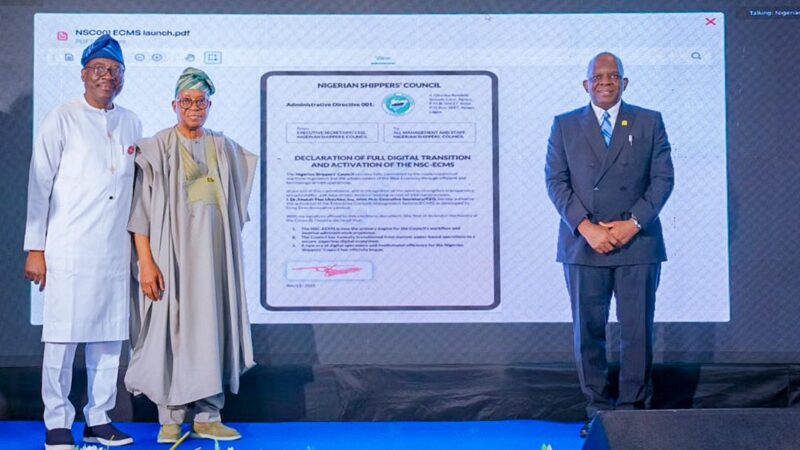
The Nigerian Shippers’ Council has unveiled its Digital Enterprise Content Management System (ECMS) to strengthen efficiency, transparency and service delivery within the maritime and blue economy sector.
This marks a major step in Nigeria’s maritime digital transformation.
Dr Pius Akutah, Executive Secretary of Shippers’ Council, said this during the unveiling in Abuja.

Akutah described the ECMS as a transformative tool and core pillar of the council’s digitalisation agenda.
The News Agency of Nigeria (NAN) reports that the Shippers’ Council ECMS is the first comprehensive, organisation-wide digital content-management system in the Nigerian maritime regulatory space.
It focuses on operations, and on administrative efficiency, transparency, workflow automation and improved service delivery, setting a new benchmark for the maritime sector.
Akutah said that the ECM system would eliminate delays, manual file movement and administrative bottlenecks that had hindered public institutions for years.
According to him, strengthening accountability, speed and information security through the ECMS would enhance the council’s regulatory effectiveness in the maritime and blue economy sector.
“The launch responds directly to the Federal Government’s digital mandate, and the council is among early adopters, proving that full digital transition is achievable and essential,” he said.
Akutah thanked the Minister of Marine and Blue Economy, Adegboyega Oyetola, and the Secretary to the Government of the Federation (SGF) George Akume, for supporting the successful rollout of the system.
He also thanked the Head of Service, stakeholders and council staff for their support.
He urged the staff members to embrace the platform as their new operational environment and a vital tool for sustaining a modern, paperless and efficient regulatory institution.
The SGF, Sen. George Akume, urged all MDAs to embrace digital transformation in spite of the difficulties of digital adoption in public service.
He tasked public services and institutions to rise to the challenge of digitalisation responsibly.
Akume encouraged MDAs to study the ECMS implementation journey and deploy similar systems to strengthen internal administrative capacity.
He said that the initiative represented a clear demonstration of the Federal Government’s commitment to modernising public administration through integrated digital governance.
According to him, the ECMS eliminates inefficiencies, delays and opacity linked to paper-based processes and manual workflows in public institutions.
Akume said that audit trails, secure approvals, workflow automation and centralised documentation aligned with global standards, ensuring accountability, reducing bottlenecks and improving responses to maritime industry challenges.
He commended the Shippers’ Council boss for implementing the system in line with the presidential directive on digital records management.
He described the rollout as a major step toward improving ease of doing business and modernising government operations nationwide.
The SGF also commended Oyetola for providing strategic leadership in the marine and blue economy sector, enabling the ECMS rollout by the nation’s port economic regulator.
Also speaking, Oyetola described the launch as a significant milestone in Nigeria’s move toward a modern, technology-driven maritime administration.
The minister said that digital transformation was central to repositioning Nigeria as an efficient and competitive maritime nation aligned with global trade demands.
He said that the theme reflected the need for technologies that improved speed, precision and institutional performance across the maritime sector.
Oyetola said that, although internal, the ECMS would extend benefits beyond administration by improving service delivery, reducing delays and enhancing predictable, transparent regulatory interventions.
“Automated workflows, secure approvals and centralised information will cut turnaround times, improve port performance and boost Nigeria’s competitiveness regionally and globally,” he said.
Oyetola highlighted broader maritime reforms, including clearing the Apapa gridlock, Federal Government’s approving of port modernisation and establishing inland dry ports across all zones.
He said that these reforms aimed to stimulate trade and deepen economic inclusion nationwide.
In her remarks, the Head of Service, Didi Walson-Jack, reaffirmed the Federal Government’s commitment to a fully digital, paperless administrative structure by the end of 2025.
She praised the Shippers’ Council for leading by example and aligning with the presidential directive on digital records management.
Walson-Jack said that the ECMS demonstrated readiness for future governance where automation replaces manual and paper-based processes. (NAN)(www.nannews.ng)
Edited by Kadiri Abdulrahman