By Felicia Imohimi
Dr Abiodun Sanni, National Project Coordinator, Federal Government/IFAD-Livelihood Improvement Family Enterprises in the Niger Delta (LIFE-ND), says the project has increased the household incomes of beneficiaries by 50 per cent.
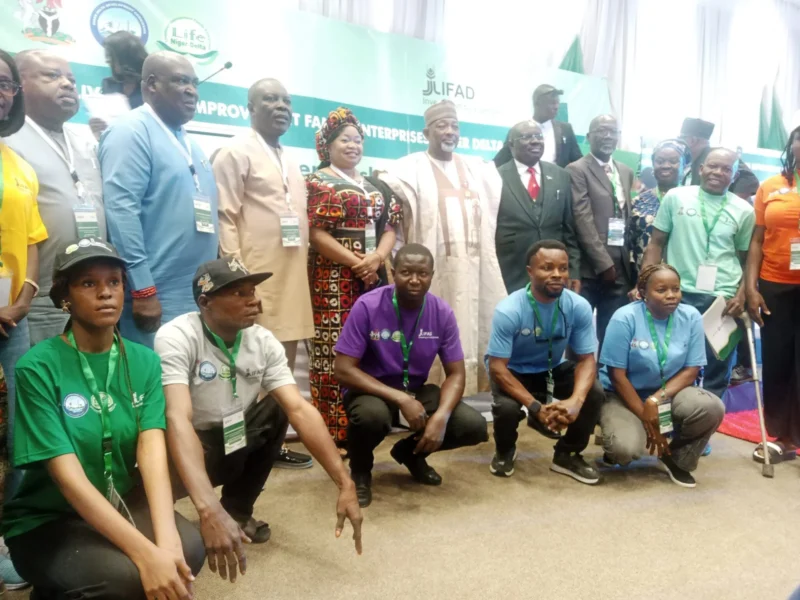
Sanni stated this at the Federal Government/IFAD-LIFE-ND High-Level Event on Scaling Up Youth Agripreneurship for Food Systems Transformation on Tuesday in Abuja.
The event was organised by the Federal Government, Niger Delta Development Commission (NDDC), IFAD and the LIFE-ND programme.
He presented a paper titled “Key Achievements, Lessons, and Scaling-Up Strategy of the LIFE-ND Project for Sustainable Youth Agripreneurship and Food System Transformation in Nigeria”.
Sanni said the income gains have contributed to poverty reduction and community resilience across the region.
He said the project had also created more than 23,751 direct jobs within rural communities in the nine participating states of Abia, Akwa Ibom, Bayelsa, Cross River, Delta, Edo, Imo, Ondo and Rivers.
Sanni listed other achievements to include enterprise development support through start-up capital, production inputs, market linkages, aggregation centres, value addition and agro-processing platforms.
On environmental and gender impacts, he said the project ensured at least 50 per cent gender inclusion in beneficiary selection.
“It has promoted green practices, waste recycling and environmental resilience in the Niger Delta ecosystem. Several rural market infrastructures have also been provided to support continuous economic growth and livelihoods,” he said.
He added that the project promoted climate-smart agriculture, improved seed varieties, mechanisation, digital business tools and ICT-based platforms for mentoring, extension advisory and financial inclusion.
On lessons learnt, Sanni said agriculture must be treated as a business rather than a social intervention, noting that mentorship-based incubation remains the most effective entry point for youth in agriculture.
“Access to finance remains the biggest barrier; credit guarantees and flexible funding windows are essential. Value-chain integration reduces youth drop-out rates and ensures sustainability.
“Community ownership enhances success and reduces conflict,” he said.
He added that digital technologies had become indispensable in driving efficiency, traceability and market access, while public-private partnerships were crucial for scaling impact.
The NPC said the LIFE-ND project had shown that with the right model, Nigerian youth could transition from job seekers to agripreneurs capable of strengthening the country’s food system.
“We are confident that with sustained commitment, expanded partnerships and scaling strategies, LIFE-ND will evolve into a national model for agricultural prosperity, food security and economic resilience,” he said.
Also speaking, Chief Samuel Ogbuku, Managing Director of NDDC, said the project’s mandate was to create a new generation of agripreneurs by equipping youth and women with skills, finance, mentorship and market integration.
Ogbuku, represented by Mrs Mary Nwaeke, the Commission’s Liaison Officer in Abuja, said the payment of the $30million counterpart fund by NDDC underscored its commitment to the project’s implementation. (NAN)(www.nannews.ng)
Edited by Tosin Kolade